Click on the link below to see the pictures from my Semana Santa travels, which I discussed in my last post:
Semana Santa 2010
Enjoy!
Friday, April 16, 2010


Monday, April 5, 2010
Semana Santa Travels
In Mexico, which is a Catholic country, the week before Easter is a big holiday called Semana Santa (Holy Week). A lot of people have at least part of it off from work, and my university here had a week of vacation. So, naturally, a couple of friends and I decided to do a beach trip/tour of southern Mexico. The following is an overview of the places we saw, and as always, upcoming pictures will give you a much better taste of our experience. But for now:
Acapulco, March 28-29
Our tour began when we flew into Acapulco, a popular beach on the southwestern coast of Mexico. We figured we might as well check it out and see what draws so many tourists to it every year.
Although it was clearly a tourist attraction, I really enjoyed Acapulco. First of all, it’s beautiful: huge mountains speckled with white houses line awesome beaches and the gorgeous ocean.
Acapulco also has a lot for visitors to do. For example, one night we saw famous cliff divers – local teenagers! – jump off a HUGE cliff into the water below, at night! It was pretty scary to watch but also astonishing, and I highly recommend that anyone visiting Acapulco goes to see it. We also took a boat tour of Acapulco bay, walked through a beautiful park, and of course spent some time lounging on the beach :).
Puerto Escondido, March 30-31
Overnight buses are awesome. They are cheap transportation, and they allow you to travel from one city to another city (like Acapulco to Puerto Escondido, which is what we did), without having to sacrifice a day to travel. Puerto Escondido is further south down the coast, and therefore was HOTTER! It’s a lot less touristy and a much smaller town than Acapulco; in fact, the name means “Hidden Port.” It has beautiful beaches as well, and world-famous surfing (my friends did a surfing lesson). I loved Puerto Escondido because a lot of the beaches were very locally-focused; there were lots of local Mexican families gathered to cool off from the heat, as well as many fishers who kept their boats on the same beach.
The City of Oaxaca, April 1-2
The only non-beach we went to was the city of Oaxaca, the capital of the state of Oaxaca, of which Puerto Escondido is a part. Oaxaca was a cute, colonial city with a “hippy-esque” culture of art and natural foods. Our first day there we went to the ruins of the ancient Zapotec capital city, Monte Albán, which sits on top of a hill right outside of Oaxaca.
The following day we had the opportunity to go for a hike in the Sierra Norte mountains outside of the city. It was amazing. Not only did we get to experience the natural beauty of the mountains, but we also learned a little bit about the mountain village life, as our guide was a woman who lived in the village at the top of the mountain on which we hiked.
Lastly, as a closing to our trip, back in the city of Oaxaca we were fortunate enough to see a Guelaguetza show, which is a Oaxacan folk dance that showcases incredibly beautiful and colorful costumes!:

As always, stay tuned for more pictures.
Acapulco, March 28-29
Our tour began when we flew into Acapulco, a popular beach on the southwestern coast of Mexico. We figured we might as well check it out and see what draws so many tourists to it every year.
Although it was clearly a tourist attraction, I really enjoyed Acapulco. First of all, it’s beautiful: huge mountains speckled with white houses line awesome beaches and the gorgeous ocean.

Acapulco also has a lot for visitors to do. For example, one night we saw famous cliff divers – local teenagers! – jump off a HUGE cliff into the water below, at night! It was pretty scary to watch but also astonishing, and I highly recommend that anyone visiting Acapulco goes to see it. We also took a boat tour of Acapulco bay, walked through a beautiful park, and of course spent some time lounging on the beach :).
Puerto Escondido, March 30-31
Overnight buses are awesome. They are cheap transportation, and they allow you to travel from one city to another city (like Acapulco to Puerto Escondido, which is what we did), without having to sacrifice a day to travel. Puerto Escondido is further south down the coast, and therefore was HOTTER!
 It’s a lot less touristy and a much smaller town than Acapulco; in fact, the name means “Hidden Port.” It has beautiful beaches as well, and world-famous surfing (my friends did a surfing lesson). I loved Puerto Escondido because a lot of the beaches were very locally-focused; there were lots of local Mexican families gathered to cool off from the heat, as well as many fishers who kept their boats on the same beach.
The City of Oaxaca, April 1-2
The only non-beach we went to was the city of Oaxaca, the capital of the state of Oaxaca, of which Puerto Escondido is a part. Oaxaca was a cute, colonial city with a “hippy-esque” culture of art and natural foods. Our first day there we went to the ruins of the ancient Zapotec capital city, Monte Albán, which sits on top of a hill right outside of Oaxaca.
The following day we had the opportunity to go for a hike in the Sierra Norte mountains outside of the city. It was amazing.
 Not only did we get to experience the natural beauty of the mountains, but we also learned a little bit about the mountain village life, as our guide was a woman who lived in the village at the top of the mountain on which we hiked.
 Lastly, as a closing to our trip, back in the city of Oaxaca we were fortunate enough to see a Guelaguetza show, which is a Oaxacan folk dance that showcases incredibly beautiful and colorful costumes!:

As always, stay tuned for more pictures.
Sunday, February 28, 2010
Retos y Hitos/Challenges and Milestones
That is definitely the theme of this year: challenges and milestones. In the beginning my experience consisted mainly of challenges, but I think I have finally reached the point where I’m starting to see the milestones.
Although my last few posts may suggest otherwise, I am busting my butt in school. This semester I am taking the following classes:
“Flujos de Comunicación en el Continento Americano” (Flows of Communication in the American Continent). Essentially what the name says, we are studying the flow patterns of mass communication – mainly television so far – back and forth between countries, especially in the Americas. In other words, we are learning about the exportation and importation patterns of various media, from their history up to the present day, while analyzing their impact on the economies of various countries.
“Seminario de Comunicación Internacional” (International Communication Seminar). This class has a philosophical focus; we discuss and analyze international communication, starting from the concept of “nation.” Actually, we even started as basically as “what is the purpose of education?” and it was interesting to hear the perspectives of Mexican students and if/how they differed from mine.
“Investigación Cualitativa de Comunicación” (Qualitative Communication Research). Whereas last semester I took quantitative research, this qualitative research class covers the basic stages of a qualitative research investigation. We are simultaneously reading an absolutely wonderful book called “Los Hijos de Sanchez” (“The Children of Sanchez”), by anthropologist Oscar Lewis, in which he transcribed years of interviews that he conducted of the Sanchez family, who lived in a poor neighborhood in Mexico City. I highly recommend the book to everyone; it’s available in English and Spanish, and gives you a firsthand sense of one of the many cultures that reside in Mexico, as well as the culture of poverty in general and what it’s like to live from day to day not knowing where your next meal will come from.
“Responsabilidad Social Corporativa” (Corporate Social Responsibility). This class teaches us the historical and contemporary concepts of corporate social responsibility, while forcing us to question and analyze the pros and cons of this increasingly-popular idea in the business (and organizational communication) world. We even had a debate in class a few weeks ago!
I wanted to share with all of you a particular milestone I had a few weeks ago, not to brag about myself by any means, but rather to give you some insight into what it’s like to take classes in a foreign language.
Last semester I didn't participate in class. Not because I didn’t want to; I firmly believe that participating in class is one of the best ways one can learn a subject. But rather, by the time I understood what the teacher was saying (the Spanish of it), processed it, synthesized it, analyzed it, etc., they had already moved on to another subject before I had a chance to say something. It was frustrating to say the least, but that is part of the language learning process.
I cut myself some slack because I was the only non-Mexican in my classes, meaning that I was the only one who didn’t understand perfectly. I tried very hard and made progress, but even by the end of the semester I still had to ask one of my classmates every once in awhile, “What was that homework assignment, again?”
I began my second semester determined to overcome that “disability”, especially since in one of my classes we receive 3 points for participation every single class (and we get a 0 if we don’t participate). After a few weeks into the semester, I finally felt that I was understanding the class on an analytical level, and even worked up the courage to ask one question. Nevertheless, my teacher came up to me and told me that I needed to participate more – even in English was fine, but I need to participate. Well, I did not come to Mexico to participate in class in English. And although it was uncomfortable that he called me out, I was determined not to let it get to me, and to prove to him that I could do it.
It also happened that I had to do a presentation for the next session of that class as well. The way the class works is that we’ll have one assigned article that everyone has to read, which is the one we discuss, and then a student is assigned to read another article and do a presentation on it (i.e. teach the class). So, I decided to spend all weekend – literally – working on these assignments so that I would not only prove to my teacher that I could step up to the challenge, but more importantly, prove it to myself.
I was surprisingly nervous about participating in class (imagine, just a little thing like class participation can be a much bigger deal to a person in another language and country), especially since it was really the first time I had forced myself to participate. However, during the next class session, not only did I feel that I was really able to engage in the discussion on an intellectual level, but I also thought that my presentation went well and that the teacher really liked the discussion I led at the end of it. One of the greatest senses of accomplishments I’ve felt, though, was when I checked my grades online: not only did I receive a 3/3 on participation, but I got a 12/12 on the presentation! But for me, the reward was not as much in the number that my grade was, but in the fact that to me it showed that he saw and appreciated how hard I was trying, and that I had succeeded in overcoming this personal challenge that I had set for myself.
I wrote this story to give you insight into the challenges and milestones that come with studying a subject in a foreign language in a foreign country. I felt that on that day, I reached a very significant milestone in the language acquisition process, and with the confidence I gained in proving to myself that I could do it, I now participate in class on a much more regular basis. Climbing over that “bump” was uncomfortable to say the least, but after the first awkwardness of class participation, it gets easier every time.
This story also gave me a lot of empathy and appreciation for all the foreign students with whom I’ve ever had a class. Even if one’s conversational abilities in a language might be 99.99% perfect, mastering that language on an academic, intellectual level is a whole different ballgame. And I feel that I am one step closer to that goal.
**Side note: I posted various pictures from this semester so far: ice skating (yes, in Mexico!), gift exchange with Rotaract, my new house, and a cabin weekend . Check them out here**
Although my last few posts may suggest otherwise, I am busting my butt in school. This semester I am taking the following classes:
“Flujos de Comunicación en el Continento Americano” (Flows of Communication in the American Continent). Essentially what the name says, we are studying the flow patterns of mass communication – mainly television so far – back and forth between countries, especially in the Americas. In other words, we are learning about the exportation and importation patterns of various media, from their history up to the present day, while analyzing their impact on the economies of various countries.
“Seminario de Comunicación Internacional” (International Communication Seminar). This class has a philosophical focus; we discuss and analyze international communication, starting from the concept of “nation.” Actually, we even started as basically as “what is the purpose of education?” and it was interesting to hear the perspectives of Mexican students and if/how they differed from mine.
“Investigación Cualitativa de Comunicación” (Qualitative Communication Research). Whereas last semester I took quantitative research, this qualitative research class covers the basic stages of a qualitative research investigation. We are simultaneously reading an absolutely wonderful book called “Los Hijos de Sanchez” (“The Children of Sanchez”), by anthropologist Oscar Lewis, in which he transcribed years of interviews that he conducted of the Sanchez family, who lived in a poor neighborhood in Mexico City. I highly recommend the book to everyone; it’s available in English and Spanish, and gives you a firsthand sense of one of the many cultures that reside in Mexico, as well as the culture of poverty in general and what it’s like to live from day to day not knowing where your next meal will come from.
“Responsabilidad Social Corporativa” (Corporate Social Responsibility). This class teaches us the historical and contemporary concepts of corporate social responsibility, while forcing us to question and analyze the pros and cons of this increasingly-popular idea in the business (and organizational communication) world. We even had a debate in class a few weeks ago!
I wanted to share with all of you a particular milestone I had a few weeks ago, not to brag about myself by any means, but rather to give you some insight into what it’s like to take classes in a foreign language.
Last semester I didn't participate in class. Not because I didn’t want to; I firmly believe that participating in class is one of the best ways one can learn a subject. But rather, by the time I understood what the teacher was saying (the Spanish of it), processed it, synthesized it, analyzed it, etc., they had already moved on to another subject before I had a chance to say something. It was frustrating to say the least, but that is part of the language learning process.
I cut myself some slack because I was the only non-Mexican in my classes, meaning that I was the only one who didn’t understand perfectly. I tried very hard and made progress, but even by the end of the semester I still had to ask one of my classmates every once in awhile, “What was that homework assignment, again?”
I began my second semester determined to overcome that “disability”, especially since in one of my classes we receive 3 points for participation every single class (and we get a 0 if we don’t participate). After a few weeks into the semester, I finally felt that I was understanding the class on an analytical level, and even worked up the courage to ask one question. Nevertheless, my teacher came up to me and told me that I needed to participate more – even in English was fine, but I need to participate. Well, I did not come to Mexico to participate in class in English. And although it was uncomfortable that he called me out, I was determined not to let it get to me, and to prove to him that I could do it.
It also happened that I had to do a presentation for the next session of that class as well. The way the class works is that we’ll have one assigned article that everyone has to read, which is the one we discuss, and then a student is assigned to read another article and do a presentation on it (i.e. teach the class). So, I decided to spend all weekend – literally – working on these assignments so that I would not only prove to my teacher that I could step up to the challenge, but more importantly, prove it to myself.
I was surprisingly nervous about participating in class (imagine, just a little thing like class participation can be a much bigger deal to a person in another language and country), especially since it was really the first time I had forced myself to participate. However, during the next class session, not only did I feel that I was really able to engage in the discussion on an intellectual level, but I also thought that my presentation went well and that the teacher really liked the discussion I led at the end of it. One of the greatest senses of accomplishments I’ve felt, though, was when I checked my grades online: not only did I receive a 3/3 on participation, but I got a 12/12 on the presentation! But for me, the reward was not as much in the number that my grade was, but in the fact that to me it showed that he saw and appreciated how hard I was trying, and that I had succeeded in overcoming this personal challenge that I had set for myself.
I wrote this story to give you insight into the challenges and milestones that come with studying a subject in a foreign language in a foreign country. I felt that on that day, I reached a very significant milestone in the language acquisition process, and with the confidence I gained in proving to myself that I could do it, I now participate in class on a much more regular basis. Climbing over that “bump” was uncomfortable to say the least, but after the first awkwardness of class participation, it gets easier every time.
This story also gave me a lot of empathy and appreciation for all the foreign students with whom I’ve ever had a class. Even if one’s conversational abilities in a language might be 99.99% perfect, mastering that language on an academic, intellectual level is a whole different ballgame. And I feel that I am one step closer to that goal.
**Side note: I posted various pictures from this semester so far: ice skating (yes, in Mexico!), gift exchange with Rotaract, my new house, and a cabin weekend . Check them out here**
Tuesday, February 23, 2010
Friday, February 5, 2010
Tour de México Part 2
I hope you all have had enough time to read my last post about Part 1 of my holiday travels around Mexico. If not, go back and read that one first! :)
Like I said last time, after Puebla, a town in central Mexico about an hour south of Mexico City, I flew to Memphis, Tennessee, where I spent Christmas with my dad, my brother and sister, my dad’s girlfriend, and her two daughters. I was debating for awhile whether or not I wanted to go home for the holidays, but ironically, Mexico made me decide to go. The culture here is so family-oriented that it has really made me appreciate my own family, and I couldn’t imagine spending the holidays without them.
After Christmas, my brother, sister, and I flew to New Hope, Pennsylvania, to where my mom just recently moved. There we spent New Years with my mom, her boyfriend, his daughter, and my boyfriend, who flew up from South Carolina. Needless to say, my family is rapidly expanding! And I love it.
However, as this is a blog about Mexico, I won’t go into too many details about my time at home. Just know that I had a wonderful time, and it was a great refresher to kick off my second semester in Monterrey.
Cancun: January 1-3
On January 1, my brother, sister, boyfriend, and I flew from Pennsylvania to Cancun, Mexico, where we met my dad for a week of traveling through the Yucatan peninsula. I was very excited to show them the country that to me has become like home. However, my one previous time in the Yucatan peninsula was 6 hours in Tulum off of a cruise ship, so this part of Mexico was almost all new to me too!
Cancun is divided into two parts: 1) downtown Cancun, which is the main city, where all “normal” life goes on, and 2) the “Zona Hotelera” (Hotel Zone), which is a peninsula jutting out into the Caribbean, where all of the tourist resorts are. We spent our one full day there wandering a few different beaches in the Zona Hotelera, and discovered that the stories are true: Cancun has amazing beaches. However, as great as the beaches were, we also discovered that Cancun is best if you have money to splurge on the beachfront resorts (which we didn’t). Instead, we stayed in a basic, but cute, locally owned hotel in downtown Cancun, and enjoyed getting to know the more “local” culture. We did, however, still enjoy a great seafood meal at a water-side restaurant in the Zona Hotelera and watched the sunset!
Tulum: January 3-7
From Cancun, we took a bus to Tulum, which is a few hours south of Cancun. It is another incredibly beautiful beach town, but with a much more relaxed, “hippy” vibe (great for my family, which is made up of a bunch of people who should have been born in the 60s ;) ).
One of the things that Tulum is famous for is its Mayan ruins site, which was actually just about a ten minute walk from our hotel! I had already been there once on the cruise a few years ago, but it was still amazing to go back! Not only is it fascinating to see the ruins of an indigenous tribe that were built hundreds and hundreds of years ago, but the ruins are on a cliff overlooking the clearest green water of the Caribbean Sea and the whitest sand I’ve ever seen.


In my opinion, Tulum is one of the best places in Mexico you can vacation to. There you can relax on some of the most gorgeous beaches in the world while walking through an extraordinary piece of Mexico’s history. After we walked around the ruins, we walked down to the beach below and relaxed for the afternoon.
The next two days in Tulum we spent renting bikes and discovering that there were even more spectacular beaches! In fact, Tulum was set up along a long strip of beach, so we could ride our bikes on the road next to the beaches and pick where we wanted to go! Just like the beach by the ruins, the sand was the whitest I had ever seen and the water the clearest. There’s not much else I can say about the beaches except that it was paradise. I highly recommend Tulum as a relaxing vacation get-away; it is my idea of perfection. In fact, we ended up staying an extra day because we couldn’t pull ourselves away!
I would be remiss if I didn’t mention something else that Tulum was perfect for: a marriage proposal! My dad’s girlfriend Jennifer flew in on Wednesday, January 6, to spend the second half of the week with us. That evening, on the perfect beach, under a perfect sunset, my dad proposed! We kids were all waiting for them at a beachside restaurant, where we celebrated with a wonderful dinner, wine, and live music.
Chichén Itzá: January 7
On Thursday, January 7, we rented a car to drive to Mérida, the capital of Yucatan, located on the west side of the peninsula about 30 minutes from the Gulf of Mexico.
Before arriving in Mérida, though, we made a stop halfway at Chichén Itzá, the most famous of the Mayan ruins sites, and one of the new seven wonders of the world. Chichén Itzá is so much more than the ruins in Tulum, and so much more than just another ruins site. It is strongly recommended that you hire a guide, which we did, because he will explain to you all of the archeological intricacies that make the site so unique.

It is made up of temples and pyramids that are ingeniously crafted to coincide with the Mayan astronomical calendar. For example, on the vernal and autumnal equinoxes every year, at particular times of day, the sun shines on the main temple, El Castillo, in such a way that it produces an illusion of a serpent crawling down the temple’s stairs:

**I took this picture from http://www.diagnosis2012.co.uk/kuk.gif so that you can see the snake on the day of the equinox. Can you see it there towards the left??
In fact, the whole structure of El Castillo is essentially designed to be a Mayan calendar, where each of the levels and staircases are the days and months of the year.
The acoustics in Chichén Itzá are also very scientific. For example, in the Gran Juego de Pelota (the great ball court where the Mayans would play an ingenious ball game, although no one is sure exactly how it was played), if you clap you can hear the clap echoed clearly 7 times.
Every night at Chichén Itzá there is a light show, which you can attend for free if you toured the site that day. We decided to stay to see it, and we were so glad we did! The temples and structures were lit up in different colors as the whole history of the place was told:

Whereas I believe that Tulum is one of the best beaches you can go to in Mexico, if you’re looking to experience Mexico’s rich history, I highly recommend Chichén Itzá.
Mérida: January 7-9
Mérida is a great colonial city, much like Puebla (which, if you remember, was the last place I went in central Mexico before going home for the holidays). As it is the capital of the Yucatan, it is very rich is traditional Mexican culture. We spent the few days that we had there walking around and taking pictures of the central plaza, the many churches, and the beautiful architecture of the houses:

We also did a bus tour around the city which gave us a great overview of the sites and history. Like Puebla, Mérida has many beautifully-colored houses and churches.
Mérida is also known for its great hammocks (in fact, I think it’s the hammock capital of Mexico), so if you want a hammock, it’s a great place to go. We also found some great hand-woven blankets for very cheap.
Unfortunately, as we only had about a day and a half in Mérida, we didn’t have time to explore the many museums and a great many other things that the city has to offer, but we did get a wonderful overview during the time that we were there, which I will soon show you through my pictures.
Like I said last time, after Puebla, a town in central Mexico about an hour south of Mexico City, I flew to Memphis, Tennessee, where I spent Christmas with my dad, my brother and sister, my dad’s girlfriend, and her two daughters. I was debating for awhile whether or not I wanted to go home for the holidays, but ironically, Mexico made me decide to go. The culture here is so family-oriented that it has really made me appreciate my own family, and I couldn’t imagine spending the holidays without them.
After Christmas, my brother, sister, and I flew to New Hope, Pennsylvania, to where my mom just recently moved. There we spent New Years with my mom, her boyfriend, his daughter, and my boyfriend, who flew up from South Carolina. Needless to say, my family is rapidly expanding! And I love it.
However, as this is a blog about Mexico, I won’t go into too many details about my time at home. Just know that I had a wonderful time, and it was a great refresher to kick off my second semester in Monterrey.
Cancun: January 1-3
On January 1, my brother, sister, boyfriend, and I flew from Pennsylvania to Cancun, Mexico, where we met my dad for a week of traveling through the Yucatan peninsula. I was very excited to show them the country that to me has become like home. However, my one previous time in the Yucatan peninsula was 6 hours in Tulum off of a cruise ship, so this part of Mexico was almost all new to me too!
Cancun is divided into two parts: 1) downtown Cancun, which is the main city, where all “normal” life goes on, and 2) the “Zona Hotelera” (Hotel Zone), which is a peninsula jutting out into the Caribbean, where all of the tourist resorts are.
 We spent our one full day there wandering a few different beaches in the Zona Hotelera, and discovered that the stories are true: Cancun has amazing beaches. However, as great as the beaches were, we also discovered that Cancun is best if you have money to splurge on the beachfront resorts (which we didn’t). Instead, we stayed in a basic, but cute, locally owned hotel in downtown Cancun, and enjoyed getting to know the more “local” culture. We did, however, still enjoy a great seafood meal at a water-side restaurant in the Zona Hotelera and watched the sunset!
Tulum: January 3-7
From Cancun, we took a bus to Tulum, which is a few hours south of Cancun. It is another incredibly beautiful beach town, but with a much more relaxed, “hippy” vibe (great for my family, which is made up of a bunch of people who should have been born in the 60s ;) ).
One of the things that Tulum is famous for is its Mayan ruins site, which was actually just about a ten minute walk from our hotel! I had already been there once on the cruise a few years ago, but it was still amazing to go back! Not only is it fascinating to see the ruins of an indigenous tribe that were built hundreds and hundreds of years ago, but the ruins are on a cliff overlooking the clearest green water of the Caribbean Sea and the whitest sand I’ve ever seen.


In my opinion, Tulum is one of the best places in Mexico you can vacation to. There you can relax on some of the most gorgeous beaches in the world while walking through an extraordinary piece of Mexico’s history. After we walked around the ruins, we walked down to the beach below and relaxed for the afternoon.
The next two days in Tulum we spent renting bikes and discovering that there were even more spectacular beaches! In fact, Tulum was set up along a long strip of beach, so we could ride our bikes on the road next to the beaches and pick where we wanted to go! Just like the beach by the ruins, the sand was the whitest I had ever seen and the water the clearest. There’s not much else I can say about the beaches except that it was paradise. I highly recommend Tulum as a relaxing vacation get-away; it is my idea of perfection. In fact, we ended up staying an extra day because we couldn’t pull ourselves away!
I would be remiss if I didn’t mention something else that Tulum was perfect for: a marriage proposal! My dad’s girlfriend Jennifer flew in on Wednesday, January 6, to spend the second half of the week with us. That evening, on the perfect beach, under a perfect sunset, my dad proposed! We kids were all waiting for them at a beachside restaurant, where we celebrated with a wonderful dinner, wine, and live music.
Chichén Itzá: January 7
On Thursday, January 7, we rented a car to drive to Mérida, the capital of Yucatan, located on the west side of the peninsula about 30 minutes from the Gulf of Mexico.
Before arriving in Mérida, though, we made a stop halfway at Chichén Itzá, the most famous of the Mayan ruins sites, and one of the new seven wonders of the world. Chichén Itzá is so much more than the ruins in Tulum, and so much more than just another ruins site. It is strongly recommended that you hire a guide, which we did, because he will explain to you all of the archeological intricacies that make the site so unique.

It is made up of temples and pyramids that are ingeniously crafted to coincide with the Mayan astronomical calendar. For example, on the vernal and autumnal equinoxes every year, at particular times of day, the sun shines on the main temple, El Castillo, in such a way that it produces an illusion of a serpent crawling down the temple’s stairs:
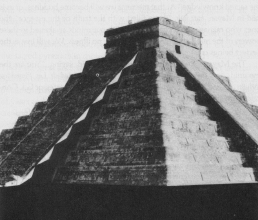
**I took this picture from http://www.diagnosis2012.co.uk/kuk.gif so that you can see the snake on the day of the equinox. Can you see it there towards the left??
In fact, the whole structure of El Castillo is essentially designed to be a Mayan calendar, where each of the levels and staircases are the days and months of the year.
The acoustics in Chichén Itzá are also very scientific. For example, in the Gran Juego de Pelota (the great ball court where the Mayans would play an ingenious ball game, although no one is sure exactly how it was played), if you clap you can hear the clap echoed clearly 7 times.
Every night at Chichén Itzá there is a light show, which you can attend for free if you toured the site that day. We decided to stay to see it, and we were so glad we did! The temples and structures were lit up in different colors as the whole history of the place was told:

Whereas I believe that Tulum is one of the best beaches you can go to in Mexico, if you’re looking to experience Mexico’s rich history, I highly recommend Chichén Itzá.
Mérida: January 7-9
Mérida is a great colonial city, much like Puebla (which, if you remember, was the last place I went in central Mexico before going home for the holidays). As it is the capital of the Yucatan, it is very rich is traditional Mexican culture. We spent the few days that we had there walking around and taking pictures of the central plaza, the many churches, and the beautiful architecture of the houses:

We also did a bus tour around the city which gave us a great overview of the sites and history. Like Puebla, Mérida has many beautifully-colored houses and churches.
Mérida is also known for its great hammocks (in fact, I think it’s the hammock capital of Mexico), so if you want a hammock, it’s a great place to go. We also found some great hand-woven blankets for very cheap.
Unfortunately, as we only had about a day and a half in Mérida, we didn’t have time to explore the many museums and a great many other things that the city has to offer, but we did get a wonderful overview during the time that we were there, which I will soon show you through my pictures.
Monday, February 1, 2010
PICTURES from Tour de Mexico Part 1!
If you all have not seen my pictures posted on my Facebook page, I finished posting my pictures from Part 1 of my travels over the winter holidays, which coincide with my previous blog post. View them by clicking on the following links:
La NANI Event with Rotaract
Guanajuato and San Miguel de Allende
Guadalajara and Puerto Vallarta
Cuernavaca (and Taxco) and Puebla
Hope you enjoy!
La NANI Event with Rotaract
Guanajuato and San Miguel de Allende
Guadalajara and Puerto Vallarta
Cuernavaca (and Taxco) and Puebla
Hope you enjoy!
Saturday, January 23, 2010
Tour de México Part 1
It’s January 23, 2010, and about two weeks ago I got back to Monterrey from my month-long Tour de México, with a brief hiatus in the good ol’ US of A for Christmas and New Year’s. Please bear with me as it will take me awhile to post all of the pictures (I think I have about 1500! And will probably just be posting a sampling), but here is a recount of my many adventures as I backpacked from place to place, hitting a different city every two or three days.
NANI with Rotaract: December 4-6
Before I even began my backpacking trip, I went on a weekend trip with the Rotaract Monterrey Club to Ciudad Valles, about 7 or 8 hours south of Monterrey. NANI stands for La Navidad por el Niño Indígena (Christmas for the Indigenous Child) and is an annual gathering of Rotaract clubs from the district. As with all Rotary activities, part of the weekend was focused on service, and part on fellowship. We arrived at midnight on Friday and there was a party going on in the fellowship hall of the hotel we stayed at. Members of Rotaract packed the room, dressed in Christmas costumes like angels and shepherds. There was a DJ playing all sorts of music, everyone was dancing, and delicious tamales were being served (a Christmas tradition in Mexico).
The next morning we were up early for the actual service part of the NANI. For months before, each of the clubs had been collecting different items to donate to the indigenous families in Ciudad Valles (for example, my club in Monterrey had been standing outside grocery stores asking for food donations). On that Saturday, the whole indigenous community about an hour outside of Ciudad Valles gathered together to accept the donations. It was an incredible experience. As a few hundred Rotaracts pulled up in buses, a few thousand indigenous people waited for us. We walked through a pathway lined with members of the community there, and they placed beautiful handmade flower leis on each one of us.

Then we walked down to the field where everyone in the indigenous community was gathered, and we handed out all the gifts we had brought them: everything from food and blankets to toys and school supplies for the children. There was entertainment going on simultaneously, and my friend Kristen even put on a stuffed bear suit and played with the kids!
It was an incredibly moving event; as we drove through the community, we could see how desperately they needed those items; it was not uncommon for them to have tin roofs and run-down houses. As the weather was beginning to get very cold, I was so glad we could give them things like blankets to keep them warm. One woman even came up and gave Kristen and me a hug to say thank you. Other than the knowledge that we were helping them out tremendously, one of my favorite parts was talking to the people of the community and learning some words from their language (most of them spoke both Spanish and an indigenous language)…unfortunately, I can’t remember what the words are anymore!
That night, Rotaract put on a fancy gala to commemorate the 15th anniversary of the NANI, which was a blast for me because we danced salsa! (For those of you who don’t know, I’m obsessed.). The next day we bussed back to Monterrey.
I spent the whole day after I got back from the NANI packing up my room. I decided to move this semester, and am now living with a friend from class and her brother. It’s about a 15 minute drive from campus, and in a more residential neighborhood than I was in last semester (I was literally living on one of the busiest streets in Monterrey). Now, I live up the side of the main mountain here, Cerro de la Silla, and have an incredible penthouse-style view of the other mountains and the city below!

After I ran around getting everything moved to my new house, I had just about enough time to enjoy one last leisurely dinner with several of my international friends, all of whom were leaving after the semester. Then we grabbed our bags and headed to the bus station for an overnight trip to Guanajuato!
Guanajuato: December 8-10
Guanajuato is the most picturesque town I’ve seen in Mexico. It’s a couple hours northwest of Mexico City, located in the mountains. It has a Venice-esque feel of old brick, colonial houses and narrow alley-ways, only with cobblestone pathways rather than canals. We stayed at an adorable little hotel called Casa Bertha, which had a terrace overlooking the colorfully packed houses of the city.
However, we had an even better view of the sprawl of the city when we climbed to the lookout:

We had just recently seen a new Mexican movie in the theaters called El Estudiante, and as it was filmed at the University of Guanajuato, we made sure to walk around its campus [side note: El Estudiante is about an old man who decides to return to school and enters the University of Guanajuato. It was so good it brought tears to my eyes, and although I’m not sure if it can be found in the U.S., I highly recommend that you try! It’s like a breath of fresh air seeing a movie made straight from Mexico]. Anyway, the university campus is really actually just one big building, and like everything else in the city, it is made of very old architecture; I felt like I was living 100 years ago!
Another Guanajuato favorite was the childhood house of Mexican muralist Diego Rivera, where he lived till he was ten years old. The first floor was still set up like a house, but the rest of the floors were a museum with a lot of Rivera’s work as well as some other guest artists.
Guanajuato was by far my favorite of the cities in central Mexico, so I highly recommend it to anyone who wants a true Mexican pueblo with a lot of history, cultural, architecture, landscape, and overall beauty. As with all the places I will describe in this entry, my pictures will tell a better story than my words, so once I post all of my pictures you will have a better idea of what I did and saw.
San Miguel de Allende: December 10-11
San Miguel de Allende is another cute, colonial town, but I have to say that I was spoiled with Guanajuato. However, San Miguel is blessed with countless beautiful cathedrals and churches, so we spent a lot of time just walking around taking pictures (and eating. We did a lot of eating not only here but everywhere we went!). It also had a great artisan market, where I was able to get some good Christmas shopping in.
Guadalajara: December 11-14
Although I already said that Guanajuato was my favorite city that we saw, I had the most fun in Guadalajara. As usually happens at busy hostels, we became instant best friends with the people staying at ours: an assortment from England, Scotland, Canada, Colombia, the United States, France, and then us, at this point a group from the United States, Australia, and Sweden (my travel group metamorphosed several times throughout the trip as people came and went).
Guadalajara is about five hours from Mexico’s western coast, and just a couple hours from the town of Tequila. So, needless to say, we had to tour Tequila, the birthplace of one of the best things to come out of Mexico (just kidding :P). It was a full-day tour, and included transportation, lunch, tours of two distilleries, and of course, tequila. Believe it or not, I actually learned a lot that day! At the first distillery, called “Tres Mujeres” Distillery, we learned that tequila is made from a plant called agave. And when you buy tequila in the store, make sure you look for “100% agave” written on the label, because if the percentage is less, it’s not true tequila. We went out to the fields at the distillery where the agave plants grow. They look like a huge pineapple, and there is a field worker called a jimador who uses a shovel-looking tool to slice off the big leaves, which are not needed.
Then the main part of the agave plant is squeezed into a juice and distilled to become tequila. At the end of the tour of this distillery, we sampled the main four different types of tequila that the factory produced, in order of the distillation length and darkness: “blanco” (white/clear tequila, the least distilled), “reposado,” “añejo,” and “extra añejo” (darkest and the most distilled).
The “Tres Mujeres” factory was a medium-seized distillery, and the one we toured in the afternoon was a small, family-owned distillery. The Jose Cuervo distillery was also there, but unfortunately we didn’t have a chance to tour it!
In Guadalajara, we also spent a day in Tlaquepaque, one of the best shopping markets in Mexico (i.e. more Christmas shopping!). There was a variety of artisan stands and more expensive shops. Guadalajara also has another market, one of the biggest in Mexico. Literally, it was three HUGE floors! We took advantage of some inexpensive local food there.
All in all, Guadalajara is a great cultural city with a lot of local things to do, see, and buy. One of the best things (in my opinion): it’s WARM all year round!
Puerto Vallarta: December 14-18
Puerto Vallarta is the closest beach to Guadalajara, about a five hour bus ride, so we went there next. There is not much in terms of culture or history there, but there were plenty of beautiful beaches! We ended up staying there longer than planned (we were going to go to Colima but decided to skip it), and had a wonderful time exploring the town and its various beaches. Here, too, we stayed at a great hostel, called “Hostal de les Artistes” (it was a French name – did I write it right?? I only do Spanish:) ). It was very hippy/artsy; the owner of it had made all sorts of artwork out of rolled up, painted newspaper: wall hangings, rugs, even an entire wall of our room was made of it! This hostel also had a terrace, and one night we had a barbeque with all the hostel guests and owners. Great place, great people. The only problem we had was actually finding the place! We took a cab from the bus station the night we got in, and gave the cab driver the address. Puerto Vallarta is a very hilly town, and we had him driving up and down incredibly steep hills, unable to find the place. However, the time that I was really scared for my life was when he parked the cab on a very steep hill, got out and started running up and down the hills looking at the house numbers! He left us in the cab though, and if my friend Viktor in the front seat hadn’t pulled the emergency brake tighter, we would have rolled down the hill and crashed into some houses! Thank god for Viktor’s cool mindedness.
Cuernavaca: December 18-20
Next stop after Puerto Vallarta was Cuernavaca, a 14-hour bus ride away (don’t worry, we took the overnight bus) and about an hour south of Mexico City. We weren’t here for very long, so spent our time there just walking around, taking pictures, and eating. We sampled some delicious pozole soup, made of shredded chicken and hominy corn in a spicy broth, famous to the area. Cuernavaca is small but has a city feel, with a nice central plaza with street performances and vendors.
Another story from a hostel we stayed at (notice a theme? Hostels are definitely the way to go wherever you’re traveling!): The first night we arrived in Cuernavaca, the owners of our hostel invited us to a “Posada” at the hostel that night. A Posada is the traditional Mexican Christmas celebration, where the people divide into two groups and sing a song about the Nativity, in which one group sings part and then the other group echoes it. Tamales and soup are usually served, and this is where piñatas are used! It was so cute to watch the little kids run to the candy!
Taxco: December 19
We took a day trip from Cuernavaca to the town of Taxco, a silver-mining mountain town about an hour away. I don’t know if you all read my post about Real de Catorce back in October, but Taxco reminded me a lot of Real: quiet, magical, and withdrawn from the world. When we arrived we went to what we thought was going to be an actual mine tour, but it was just a small room designed as a mine for tourists. Nevertheless, they had some wonderful silver jewelry there.
Another Taxco attraction that we took advantage of was a cable car that took us across the Taxco valley and gave us an incredible view of the mountain below, speckled with cute white houses:

Taxco is an off-the-beaten-path town where I would definitely recommend going. The main tourists we saw were Mexican!
Puebla: December 20-22
Our last stop before my brief hiatus to the U.S. for the holidays was Puebla. Puebla is east of Cuernavaca and also about an hour south of Mexico City. This city of 1.5 million was another Tour de México favorite for me. To me, Puebla is one of the Mexican cities that best gives you a sense that you are in “true Mexico” (It is a lot like Mérida, in the Yucatan peninsula. Stay tuned for a description of my time in Mérida in my next post!).
Puebla has grid-like streets and houses of identical size, all attached to each other but of every color you could imagine. It’s known for its culture of high society and conservatism, but understandably so, as it is something to be proud of. We did a bus tour that took us around all the main historical points of the city, and gave us a great sense of the colonialism that still exists there: there were churches and cathedrals on every street corner it seemed. Puebla is also a significant location in Mexico’s history, as it has the fortress that protected the locals against the French on May 5, 1862, which inspired the Cinco de Mayo celebrations that I’m sure you all celebrate now.
Puebla is also very well known for its DELICIOUS cuisine. Ever heard of mole? That’s from Puebla. Poblano pepper? Also from Puebla. Anything that has the word “poblano” in it means that it comes from Puebla. Actually, when we were there the seasonal specialty was cooked crickets, but I decided to stick with something a little bit more food-ish. It was a chicken dish with a green sauce made from pumpkin seeds called pipian verde, and it was superb. Try it if you go to Puebla!
My favorite thing about Puebla (and one of my favorite things about the whole trip) was a hole-in-the-wall coffee shop we found one night (actually, we were recommended by Lonely Planet, hands down the best travel book you can get). It was also a library and had shelves of books and a dark, relaxed ambience. It was the kind of place that only the locals know about. That night, there was an awesome jazzy salsa band, and everyone in the place got up and danced! It wasn’t even just couples; half of the people were just dancing on their own, doing their own interpretive salsa dancing. We had a blast just watching them – like most Mexicans, they knew how to dance!!
Puebla was by far the coldest place we went on our trip. One of my most vivid memories, unfortunately, was a few cooooold hours I spent in the airport on December 22, on my way home to the U.S. to celebrate the holidays with my family. The airport had no heating system, as it is normally not needed and Mexico is experiencing more cold weather this year than usual. On top of the FREEZING cold weather, my flight (which was supposed to leave at 7 a.m.) was delayed and I wasn’t sure why. So there I was, so cold I couldn’t even stand still, watching the airport workers take their time preparing the plane. I thought that’s all they were doing until I saw the plane backing away from the gate! Confused, I decided to go up and ask some men who also appeared to be on my flight. “Oh, the flight’s delayed because there was ice on the plane, and they had to wait for the sun to come up to de-ice it! Now they’re moving it around so the sun can melt the other side.” I guess when you're not used to cold weather, you don't need de-icing machines, so you resort to nature!
Stay tuned for Part 2 of my Tour de México adventures, and lots and lots of pictures!
NANI with Rotaract: December 4-6
Before I even began my backpacking trip, I went on a weekend trip with the Rotaract Monterrey Club to Ciudad Valles, about 7 or 8 hours south of Monterrey. NANI stands for La Navidad por el Niño Indígena (Christmas for the Indigenous Child) and is an annual gathering of Rotaract clubs from the district. As with all Rotary activities, part of the weekend was focused on service, and part on fellowship. We arrived at midnight on Friday and there was a party going on in the fellowship hall of the hotel we stayed at. Members of Rotaract packed the room, dressed in Christmas costumes like angels and shepherds. There was a DJ playing all sorts of music, everyone was dancing, and delicious tamales were being served (a Christmas tradition in Mexico).
The next morning we were up early for the actual service part of the NANI. For months before, each of the clubs had been collecting different items to donate to the indigenous families in Ciudad Valles (for example, my club in Monterrey had been standing outside grocery stores asking for food donations). On that Saturday, the whole indigenous community about an hour outside of Ciudad Valles gathered together to accept the donations. It was an incredible experience. As a few hundred Rotaracts pulled up in buses, a few thousand indigenous people waited for us. We walked through a pathway lined with members of the community there, and they placed beautiful handmade flower leis on each one of us.

Then we walked down to the field where everyone in the indigenous community was gathered, and we handed out all the gifts we had brought them: everything from food and blankets to toys and school supplies for the children. There was entertainment going on simultaneously, and my friend Kristen even put on a stuffed bear suit and played with the kids!
It was an incredibly moving event; as we drove through the community, we could see how desperately they needed those items; it was not uncommon for them to have tin roofs and run-down houses. As the weather was beginning to get very cold, I was so glad we could give them things like blankets to keep them warm. One woman even came up and gave Kristen and me a hug to say thank you. Other than the knowledge that we were helping them out tremendously, one of my favorite parts was talking to the people of the community and learning some words from their language (most of them spoke both Spanish and an indigenous language)…unfortunately, I can’t remember what the words are anymore!
That night, Rotaract put on a fancy gala to commemorate the 15th anniversary of the NANI, which was a blast for me because we danced salsa! (For those of you who don’t know, I’m obsessed.). The next day we bussed back to Monterrey.
I spent the whole day after I got back from the NANI packing up my room. I decided to move this semester, and am now living with a friend from class and her brother. It’s about a 15 minute drive from campus, and in a more residential neighborhood than I was in last semester (I was literally living on one of the busiest streets in Monterrey). Now, I live up the side of the main mountain here, Cerro de la Silla, and have an incredible penthouse-style view of the other mountains and the city below!

After I ran around getting everything moved to my new house, I had just about enough time to enjoy one last leisurely dinner with several of my international friends, all of whom were leaving after the semester. Then we grabbed our bags and headed to the bus station for an overnight trip to Guanajuato!
Guanajuato: December 8-10
Guanajuato is the most picturesque town I’ve seen in Mexico. It’s a couple hours northwest of Mexico City, located in the mountains. It has a Venice-esque feel of old brick, colonial houses and narrow alley-ways, only with cobblestone pathways rather than canals. We stayed at an adorable little hotel called Casa Bertha, which had a terrace overlooking the colorfully packed houses of the city.
However, we had an even better view of the sprawl of the city when we climbed to the lookout:

We had just recently seen a new Mexican movie in the theaters called El Estudiante, and as it was filmed at the University of Guanajuato, we made sure to walk around its campus [side note: El Estudiante is about an old man who decides to return to school and enters the University of Guanajuato. It was so good it brought tears to my eyes, and although I’m not sure if it can be found in the U.S., I highly recommend that you try!
 It’s like a breath of fresh air seeing a movie made straight from Mexico]. Anyway, the university campus is really actually just one big building, and like everything else in the city, it is made of very old architecture; I felt like I was living 100 years ago!
Another Guanajuato favorite was the childhood house of Mexican muralist Diego Rivera, where he lived till he was ten years old. The first floor was still set up like a house, but the rest of the floors were a museum with a lot of Rivera’s work as well as some other guest artists.
Guanajuato was by far my favorite of the cities in central Mexico, so I highly recommend it to anyone who wants a true Mexican pueblo with a lot of history, cultural, architecture, landscape, and overall beauty. As with all the places I will describe in this entry, my pictures will tell a better story than my words, so once I post all of my pictures you will have a better idea of what I did and saw.
San Miguel de Allende: December 10-11
San Miguel de Allende is another cute, colonial town, but I have to say that I was spoiled with Guanajuato. However, San Miguel is blessed with countless beautiful cathedrals and churches,
 so we spent a lot of time just walking around taking pictures (and eating. We did a lot of eating not only here but everywhere we went!). It also had a great artisan market, where I was able to get some good Christmas shopping in.
 Guadalajara: December 11-14
Although I already said that Guanajuato was my favorite city that we saw, I had the most fun in Guadalajara. As usually happens at busy hostels, we became instant best friends with the people staying at ours: an assortment from England, Scotland, Canada, Colombia, the United States, France, and then us, at this point a group from the United States, Australia, and Sweden (my travel group metamorphosed several times throughout the trip as people came and went).
Guadalajara is about five hours from Mexico’s western coast, and just a couple hours from the town of Tequila. So, needless to say, we had to tour Tequila, the birthplace of one of the best things to come out of Mexico (just kidding :P). It was a full-day tour, and included transportation, lunch, tours of two distilleries, and of course, tequila. Believe it or not, I actually learned a lot that day! At the first distillery, called “Tres Mujeres” Distillery, we learned that tequila is made from a plant called agave. And when you buy tequila in the store, make sure you look for “100% agave” written on the label, because if the percentage is less, it’s not true tequila.
 We went out to the fields at the distillery where the agave plants grow. They look like a huge pineapple, and there is a field worker called a jimador who uses a shovel-looking tool to slice off the big leaves, which are not needed.
Then the main part of the agave plant is squeezed into a juice and distilled to become tequila. At the end of the tour of this distillery, we sampled the main four different types of tequila that the factory produced, in order of the distillation length and darkness: “blanco” (white/clear tequila, the least distilled), “reposado,” “añejo,” and “extra añejo” (darkest and the most distilled).
The “Tres Mujeres” factory was a medium-seized distillery, and the one we toured in the afternoon was a small, family-owned distillery. The Jose Cuervo distillery was also there, but unfortunately we didn’t have a chance to tour it!
In Guadalajara, we also spent a day in Tlaquepaque, one of the best shopping markets in Mexico (i.e. more Christmas shopping!). There was a variety of artisan stands and more expensive shops. Guadalajara also has another market, one of the biggest in Mexico. Literally, it was three HUGE floors! We took advantage of some inexpensive local food there.
All in all, Guadalajara is a great cultural city with a lot of local things to do, see, and buy. One of the best things (in my opinion): it’s WARM all year round!
Puerto Vallarta: December 14-18
Puerto Vallarta is the closest beach to Guadalajara, about a five hour bus ride, so we went there next. There is not much in terms of culture or history there, but there were plenty of beautiful beaches! We ended up staying there longer than planned (we were going to go to Colima but decided to skip it), and had a wonderful time exploring the town and its various beaches.
 Here, too, we stayed at a great hostel, called “Hostal de les Artistes” (it was a French name – did I write it right?? I only do Spanish:) ). It was very hippy/artsy; the owner of it had made all sorts of artwork out of rolled up, painted newspaper: wall hangings, rugs, even an entire wall of our room was made of it! This hostel also had a terrace, and one night we had a barbeque with all the hostel guests and owners. Great place, great people. The only problem we had was actually finding the place! We took a cab from the bus station the night we got in, and gave the cab driver the address. Puerto Vallarta is a very hilly town, and we had him driving up and down incredibly steep hills, unable to find the place. However, the time that I was really scared for my life was when he parked the cab on a very steep hill, got out and started running up and down the hills looking at the house numbers! He left us in the cab though, and if my friend Viktor in the front seat hadn’t pulled the emergency brake tighter, we would have rolled down the hill and crashed into some houses! Thank god for Viktor’s cool mindedness.
 Cuernavaca: December 18-20
Next stop after Puerto Vallarta was Cuernavaca, a 14-hour bus ride away (don’t worry, we took the overnight bus) and about an hour south of Mexico City. We weren’t here for very long, so spent our time there just walking around, taking pictures, and eating. We sampled some delicious pozole soup, made of shredded chicken and hominy corn in a spicy broth, famous to the area. Cuernavaca is small but has a city feel, with a nice central plaza with street performances and vendors.
Another story from a hostel we stayed at (notice a theme? Hostels are definitely the way to go wherever you’re traveling!): The first night we arrived in Cuernavaca, the owners of our hostel invited us to a “Posada” at the hostel that night. A Posada is the traditional Mexican Christmas celebration, where the people divide into two groups and sing a song about the Nativity, in which one group sings part and then the other group echoes it. Tamales and soup are usually served, and this is where piñatas are used! It was so cute to watch the little kids run to the candy!
Taxco: December 19
We took a day trip from Cuernavaca to the town of Taxco, a silver-mining mountain town about an hour away. I don’t know if you all read my post about Real de Catorce back in October, but Taxco reminded me a lot of Real: quiet, magical, and withdrawn from the world. When we arrived we went to what we thought was going to be an actual mine tour, but it was just a small room designed as a mine for tourists. Nevertheless, they had some wonderful silver jewelry there.
Another Taxco attraction that we took advantage of was a cable car that took us across the Taxco valley and gave us an incredible view of the mountain below, speckled with cute white houses:

Taxco is an off-the-beaten-path town where I would definitely recommend going. The main tourists we saw were Mexican!
Puebla: December 20-22
Our last stop before my brief hiatus to the U.S. for the holidays was Puebla. Puebla is east of Cuernavaca and also about an hour south of Mexico City. This city of 1.5 million was another Tour de México favorite for me. To me, Puebla is one of the Mexican cities that best gives you a sense that you are in “true Mexico” (It is a lot like Mérida, in the Yucatan peninsula. Stay tuned for a description of my time in Mérida in my next post!).
Puebla has grid-like streets and houses of identical size, all attached to each other but of every color you could imagine. It’s known for its culture of high society and conservatism, but understandably so, as it is something to be proud of.
 We did a bus tour that took us around all the main historical points of the city, and gave us a great sense of the colonialism that still exists there: there were churches and cathedrals on every street corner it seemed. Puebla is also a significant location in Mexico’s history, as it has the fortress that protected the locals against the French on May 5, 1862, which inspired the Cinco de Mayo celebrations that I’m sure you all celebrate now.
 Puebla is also very well known for its DELICIOUS cuisine. Ever heard of mole? That’s from Puebla. Poblano pepper? Also from Puebla. Anything that has the word “poblano” in it means that it comes from Puebla. Actually, when we were there the seasonal specialty was cooked crickets, but I decided to stick with something a little bit more food-ish. It was a chicken dish with a green sauce made from pumpkin seeds called pipian verde, and it was superb. Try it if you go to Puebla!
My favorite thing about Puebla (and one of my favorite things about the whole trip) was a hole-in-the-wall coffee shop we found one night (actually, we were recommended by Lonely Planet, hands down the best travel book you can get). It was also a library and had shelves of books and a dark, relaxed ambience. It was the kind of place that only the locals know about. That night, there was an awesome jazzy salsa band, and everyone in the place got up and danced! It wasn’t even just couples; half of the people were just dancing on their own, doing their own interpretive salsa dancing. We had a blast just watching them – like most Mexicans, they knew how to dance!!
Puebla was by far the coldest place we went on our trip. One of my most vivid memories, unfortunately, was a few cooooold hours I spent in the airport on December 22, on my way home to the U.S. to celebrate the holidays with my family. The airport had no heating system, as it is normally not needed and Mexico is experiencing more cold weather this year than usual. On top of the FREEZING cold weather, my flight (which was supposed to leave at 7 a.m.) was delayed and I wasn’t sure why. So there I was, so cold I couldn’t even stand still, watching the airport workers take their time preparing the plane. I thought that’s all they were doing until I saw the plane backing away from the gate! Confused, I decided to go up and ask some men who also appeared to be on my flight. “Oh, the flight’s delayed because there was ice on the plane, and they had to wait for the sun to come up to de-ice it! Now they’re moving it around so the sun can melt the other side.” I guess when you're not used to cold weather, you don't need de-icing machines, so you resort to nature!
Stay tuned for Part 2 of my Tour de México adventures, and lots and lots of pictures!
Thursday, December 3, 2009
Pictures: Bull Fight and Thanksgiving
Click here to see pictures from both of my Thanksgivings
Click here to see pictures from a Mexican bull fight
(**Please note that this does have some pictures that might be considered disturbing, but it is worth looking at because it was an interesting cultural experience)
Click here to see pictures from a Mexican bull fight
(**Please note that this does have some pictures that might be considered disturbing, but it is worth looking at because it was an interesting cultural experience)
Tuesday, December 1, 2009
Thanksgiving in Mexico
The week before Thanksgiving, while those of you in the States were happily surrounded by Thanksgiving food, decorations, sales, and overall ambience, we Americans here in Mexico were scouring the stores for items that would be staples in the United States at this time of year. Although Monterrey is close to the U.S., not very many people celebrate Thanksgiving here. There are those few Mexican-American families who celebrate it with turkey tacos (literally, I’m sure), but for the most part, it is a holiday that goes unnoticed (for obvious reasons, since it’s American!). However, for this very reason, my American friends and I decided to take advantage of this opportunity to share one of our culture’s most important traditions with both the Mexicans and the internationals here in Monterrey. In fact, I celebrated Thanksgiving twice!:
Thanksgiving #1: For the Rotaract Club
Kristen, the other Rotary Scholar here, and I realized that we wouldn’t have a more perfect opportunity than Thanksgiving to do exactly what Rotary has given us scholarships for: to further cross-cultural understanding and friendships. Thanksgiving is an all-American holiday that in and of itself celebrates friendship between cultures – the Native Americans and the pilgrims – and so we decided to share every aspect of it with the Monterrey Rotaract club: the food, the giving thanks, and the cross-cultural friendships.
We had this Thanksgiving dinner the Sunday before Thanksgiving. Kristen and I went shopping a couple of days before, crossing our fingers that we could actually find a turkey in Mexico at this time of year. We lucked out and found one at Costco! But you would never think that shopping for a holiday that for us is such a given would be so difficult. Certain things that would be at every grocery store in the U.S. we had to search high and low for in various stores here. And other things we didn’t think we would find we actually had no problem finding! For example, we had no problem finding a turkey or an already-made pumpkin pie, but we couldn’t find pumpkin-pie filling or packaged stuffing (we eventually found the stuffing at Wal-Mart after we had already started making our own). And don’t even try to get fresh cranberries here. Canned cranberries, yes, but you have to dig! But, after going back and forth to Wal-Mart, Soriana, and Costco, we eventually got everything together for the Thanksgiving dinner.
We spent all day cooking on Sunday and the Rotaractors arrived around 7 p.m. Neither Kristen nor I had ever made a turkey before, but it turned out GREAT! Since none of our guests had ever experienced Thanksgiving before, we first told them the story of Thanksgiving, and then each of us went around and said what we were thankful for.
We also had a surprise visit from a man from England – a co-worker of one of the Rotaractors. He too was very excited to experience his first Thanksgiving. It’s good to know that after a few hundred years, there can be perfectly friendly relations between Americans and British, especially at a holiday like Thanksgiving! :) Really though, it was such a great experience to have Mexicans, Americans, and British gathered together, all politics aside, to celebrate one of our greatest holidays, which has become simply a recognition of the wonderful family and friends – of every culture and ethnicity – in one’s life.
Thanksgiving #2: For My International and Mexican Friends
On actual Thanksgiving Day, my friend Linda (from California) and I cooked Thanksgiving dinner for our international and Mexican friends here. This time I knew exactly which stores sold which products, and I knew all about preparing the turkey (turkey guts don’t phase me anymore). I have to say, I was pretty proud of the cooking skills I developed, considering that I did not even used to be able to make pasta! (Yes, even after college).
Anyway, everything turned out great for this Thanksgiving too. No one here had ever experienced the holiday either, so again, we loved being able to bring this American tradition to Mexico! Also present were people from Germany, France, Australia, and Canada.
Stay tuned for pictures – will post them soon. Happy belated Thanksgiving to everyone – hope it was wonderful!
Thanksgiving #1: For the Rotaract Club
Kristen, the other Rotary Scholar here, and I realized that we wouldn’t have a more perfect opportunity than Thanksgiving to do exactly what Rotary has given us scholarships for: to further cross-cultural understanding and friendships. Thanksgiving is an all-American holiday that in and of itself celebrates friendship between cultures – the Native Americans and the pilgrims – and so we decided to share every aspect of it with the Monterrey Rotaract club: the food, the giving thanks, and the cross-cultural friendships.
We had this Thanksgiving dinner the Sunday before Thanksgiving. Kristen and I went shopping a couple of days before, crossing our fingers that we could actually find a turkey in Mexico at this time of year. We lucked out and found one at Costco! But you would never think that shopping for a holiday that for us is such a given would be so difficult. Certain things that would be at every grocery store in the U.S. we had to search high and low for in various stores here. And other things we didn’t think we would find we actually had no problem finding! For example, we had no problem finding a turkey or an already-made pumpkin pie, but we couldn’t find pumpkin-pie filling or packaged stuffing (we eventually found the stuffing at Wal-Mart after we had already started making our own). And don’t even try to get fresh cranberries here. Canned cranberries, yes, but you have to dig! But, after going back and forth to Wal-Mart, Soriana, and Costco, we eventually got everything together for the Thanksgiving dinner.
We spent all day cooking on Sunday and the Rotaractors arrived around 7 p.m. Neither Kristen nor I had ever made a turkey before, but it turned out GREAT!
 Since none of our guests had ever experienced Thanksgiving before, we first told them the story of Thanksgiving, and then each of us went around and said what we were thankful for.
 We also had a surprise visit from a man from England – a co-worker of one of the Rotaractors. He too was very excited to experience his first Thanksgiving. It’s good to know that after a few hundred years, there can be perfectly friendly relations between Americans and British, especially at a holiday like Thanksgiving! :) Really though, it was such a great experience to have Mexicans, Americans, and British gathered together, all politics aside, to celebrate one of our greatest holidays, which has become simply a recognition of the wonderful family and friends – of every culture and ethnicity – in one’s life.
Thanksgiving #2: For My International and Mexican Friends
On actual Thanksgiving Day, my friend Linda (from California) and I cooked Thanksgiving dinner for our international and Mexican friends here. This time I knew exactly which stores sold which products, and I knew all about preparing the turkey (turkey guts don’t phase me anymore). I have to say, I was pretty proud of the cooking skills I developed, considering that I did not even used to be able to make pasta! (Yes, even after college).
Anyway, everything turned out great for this Thanksgiving too. No one here had ever experienced the holiday either, so again, we loved being able to bring this American tradition to Mexico! Also present were people from Germany, France, Australia, and Canada.
Stay tuned for pictures – will post them soon. Happy belated Thanksgiving to everyone – hope it was wonderful!
Monday, November 16, 2009
Sunday, November 15, 2009
Weekend of El Día de los Muertos
The last weekend of October was Halloween for some, but for Mexico, it was the weekend of El Día de los Muertos (Day of the Dead), one of the main celebrations that Mexico is known for, in which the deceased are remembered and believed to come back for one day. Although officially I believe el Día de los Muertos is November 2, it is really celebrated the whole weekend before. Unfortunately for me, northern Mexico celebrates Halloween more than el Día de los Muertos (it is more celebrated in the South), but there were still some celebrations here in Monterrey.
On Friday night, October 30, I went with a few friends to an indigenous spiritual cleansing ritual in the Huasteca, which are the mountains right outside of Monterrey. We had no idea what to expect from this Noche de Temazcalli (“Night of Temazcalli”), except that we would sweat a lot, so we should bring a change of clothes and some towels.
We took a bus to a cabin in the mountains – there were about 20-30 people who came. When we arrived, we all gathered around a fire as a woman – our guide - briefly explained what we would be doing. A girl came around and performed a blessing on each of us with some kind of incense. After we were blessed, we took some twigs from a bag, threw them in the fire, and got down on hands and knees to enter a tent that was there.

The tent was made of branches and covered in blankets, and looked like an igloo. As we entered on hands and knees, we bowed our heads to the ground and then crawled in and sat down. We waited as each person individually crawled into the tent, and then the guide began to explain more about what we would be doing. She told us that the door to the tent would be closed four times, and during each time we would experience the temazcalli, which is a bath of vapor made from herb-scented water being poured onto hot, volcanic rocks. It originates from the pre-Hispanic cultures of Mexico and Central America, and the purpose is to cleanse the body and soul in conjunction with the essential elements (earth, water, fire, and air).
So they closed the door four times, and each time they poured the scented water on the hot rocks in the center of the tent. The room filled up with the HOT smell of herbs – it felt like a sauna. Everyone was dripping in sweat, and occasionally I had to lean down to the floor to get some cooler air. Each time, after about 15-20 minutes, they opened the tent door up so that we would have some fresh air. During this time, they would bring in new hot rocks, and then close the door again. Four times they did that, and we were in the tent a total of about two hours.
After sweating like crazy for two hours straight, it was intense to walk outside to the crispy mountain air, because we were soaked (it was then that we understood why we were supposed to bring a change of clothes and towels!). For the next hour, we gathered around the fire, getting to know each other. Several people had brought snacks of fruit and nuts and chocolate, and while some ate theirs, others threw theirs into the fire as an offering.
Other than the Noche de Temazcalli that weekend, several student organizations at Monterrey Tech set up altars on campus in honor of El Día de los Muertos. This is a popular tradition, which honors those who have passed away. For example, there was an altar set up by the Society of Hispanic Language and Literature Students in memory of two deceased Hispanic authors. :

There was also an altar in memory of Michael Jackson and Farrah Fawcett:

And that evening in class, my teacher brought in Day of the Dead Cake, a delicious pastry/cake that is eaten on El Día de los Muertos.
On Friday night, October 30, I went with a few friends to an indigenous spiritual cleansing ritual in the Huasteca, which are the mountains right outside of Monterrey. We had no idea what to expect from this Noche de Temazcalli (“Night of Temazcalli”), except that we would sweat a lot, so we should bring a change of clothes and some towels.
We took a bus to a cabin in the mountains – there were about 20-30 people who came. When we arrived, we all gathered around a fire as a woman – our guide - briefly explained what we would be doing. A girl came around and performed a blessing on each of us with some kind of incense. After we were blessed, we took some twigs from a bag, threw them in the fire, and got down on hands and knees to enter a tent that was there.

The tent was made of branches and covered in blankets, and looked like an igloo. As we entered on hands and knees, we bowed our heads to the ground and then crawled in and sat down. We waited as each person individually crawled into the tent, and then the guide began to explain more about what we would be doing. She told us that the door to the tent would be closed four times, and during each time we would experience the temazcalli, which is a bath of vapor made from herb-scented water being poured onto hot, volcanic rocks. It originates from the pre-Hispanic cultures of Mexico and Central America, and the purpose is to cleanse the body and soul in conjunction with the essential elements (earth, water, fire, and air).
So they closed the door four times, and each time they poured the scented water on the hot rocks in the center of the tent. The room filled up with the HOT smell of herbs – it felt like a sauna. Everyone was dripping in sweat, and occasionally I had to lean down to the floor to get some cooler air. Each time, after about 15-20 minutes, they opened the tent door up so that we would have some fresh air. During this time, they would bring in new hot rocks, and then close the door again. Four times they did that, and we were in the tent a total of about two hours.
After sweating like crazy for two hours straight, it was intense to walk outside to the crispy mountain air, because we were soaked (it was then that we understood why we were supposed to bring a change of clothes and towels!). For the next hour, we gathered around the fire, getting to know each other. Several people had brought snacks of fruit and nuts and chocolate, and while some ate theirs, others threw theirs into the fire as an offering.
Other than the Noche de Temazcalli that weekend, several student organizations at Monterrey Tech set up altars on campus in honor of El Día de los Muertos. This is a popular tradition, which honors those who have passed away. For example, there was an altar set up by the Society of Hispanic Language and Literature Students in memory of two deceased Hispanic authors. :

There was also an altar in memory of Michael Jackson and Farrah Fawcett:

And that evening in class, my teacher brought in Day of the Dead Cake, a delicious pastry/cake that is eaten on El Día de los Muertos.
Sunday, November 1, 2009
Pictures from Real de Catorce Trip...
...are posted! You can see more of the beauty that is Mexico here:
Weekend Trip to Real de Catorce
Saludos!
-Emily
Weekend Trip to Real de Catorce
Saludos!
-Emily
Friday, October 30, 2009
Pictures from Rotary and Rotaract Events in Monterrey
I finally put up some pictures from various Rotary meetings and events with Rotaract here in Monterrey! Check them out here:
Rotary and Rotaract in Monterrey
Enjoy!
Rotary and Rotaract in Monterrey
Enjoy!
Monday, October 26, 2009
A Long Over-due Update Including Trip to Real de Catorce
Hi everyone! Yep, I’m still here. Mexico hasn’t got the best of me yet. Where have I been for the last month? Well, first of all I apologize that it has been a month since the last time I wrote. Here’s a summary of the last month, which has been jam-packed with service, studying, new friends, and adventures:
ROTARACT
Rotaract is essentially a Rotary Club for people of 18-30 years of age, and there is a great Rotaract Club here in Monterrey. I’ve been participating as much as possible; they meet every Wednesday night and discuss various service projects, and I had the opportunity to participate in their “Noche de Lonche” one Sunday evening, where we made sandwiches for patients at a local hospital who are not from the area.

Read more about the Rotaract Club on their blog (in Spanish):
http://rotaractmty.blogspot.com/
ASOCIACIÓN ESTUDIANTIL POR LOS PUEBLOS INDÍGENAS (AEPI)
I’m still regularly attending meetings with this student organization at Tec that encourages awareness of indigenous people’s rights and situations. It’s really an amazing way to be exposed to more of Mexican society, which was essentially founded upon the indigenous culture, and to see how proud Mexicans are of their history and culture.
AEPI continues to be a part of the program Creando Espacios de Inclusión, in which we get together with indigenous youth in Monterrey on Saturdays and discuss a different topic every week, to make friends and to learn more about each other’s culture. My favorite session was one in which each person talked about the community he or she came from – so not only did I get to learn about various indigenous villages in Mexico, but there was one AEPI member from Uruguay! And I got to share about my home state of South Carolina, and everyone loved hearing about that.
BEING A GRAD STUDENT AT MONTERREY TEC…
…is a lot of work! I have a new respect for everyone with a Master’s degree, as well as all Mexican students:). I have a semester project for each of my four classes, and since we only have a month left of the semester (so hard to believe), it will be down to the wire soon! It’s good though – I’m learning the way the educational system works in Mexico (at least at Tec, it’s very research-oriented and group-project-focused, which is a great way to get to know the students in my class and practice my Spanish).
WEEKEND TRIP TO REAL DE CATORCE
Although I’m being kept pretty busy, I’ve made sure to give myself time to see more of this beautiful country. My boyfriend Zack came from South Carolina to visit me for a couple of weeks, and although I spent a lot of time showing him around Monterrey (places such as the Cola de Caballo waterfall and the Grutas de Garcia caves, which I described in previous posts), we also went away the first weekend in October with some of my friends here to Real de Catorce, a little colonial town in the mountain about 5 hours from Monterrey in the state of San Luis Potosi.
Have you ever seen the movie “The Mexican”? It was filmed in Real de Catorce. If you haven’t, Real can be described as Mexican western cowboy meets Mexican indigenous hippy. We decided to drive my car there, and it was a smooth, peaceful ride on a Friday afternoon with incredible views:

…until my car got stuck halfway up the mountain, at the top of which is Real de Catorce.
We were incredibly lucky though, because right then some natives were driving by. They stopped and came over to help us try and figure out what was wrong. We realized it was a problem with the transmission, because it wasn’t changing gears, so they put in some transmission fluid that they had handy. I also happened to need oil, so they took us to a little convenience store a little bit further up the mountain, and that was enough to get me to the top.
In order to get to Real de Catorce, you have to park your car in a dirt parking lot and walk through a tunnel about 2 km long. Since it was dark at this point, the tunnel was particularly spooky. In fact, Real is known for being a ghost town, although at the particular time that we were there, there was a festival going on called Fiesta de San Francisco, during which time 150,000 pilgrims come to see the figure of Saint Francis of Assisi in the church there. But even though there were people around, it was still very eerie walking through that tunnel:

It was also a very long tunnel, so about halfway through we hitched a ride with a horse and cart.
At the end of the tunnel was Real de Catorce. We came out and immediately it felt as if we had jumped back about 100 years. There were cobblestone paths and vendors on the streets, selling delicious-smelling tacos, religious souvenirs and little knick-knacks. The air was fresh and crisp and literally everything about that town was in stark contrast to the big, loud city of Monterrey. I love Monterrey, but it was a welcome change.
We wandered through the crowds of pilgrims and vendors, up and down cobblestone hills, until we came to our hotel at the other end of the village (that description makes it sound far away, but the whole town was actually pretty small. In fact, there was essentially just one main market place, with a few side streets). After we got settled into our hotel, we went in search of food, of which the options were: tacos, burritos, and other versions of tacos and burritos with different names – all from street vendors. So, we ordered delicious pork burritos and wondered why they don’t make ‘em like that in the States!
Real already seemed like a great town, but with not much to offer for nightlife. So, we opted to go relax at the bar atop our hotel, where we found a great drum band playing an indigenous-style beat. All of a sudden a indigenous man (probably a Huichol, the primary indigenous group from Real de Catorce) walked out into the middle of the room, with his hair pulled in front of his face so we couldn’t see his face at all, body painted, and wearing a striped skirt. He carried a decorated cane with a painted animal skull at the top. He began dancing to the drum beat in a rhythmic yet flowing fashion, as all eyes were on him. And then, slowly, everyone else in the room began to dance to the drums–and we joined in too!
One of the things that Real de Catorce is known for is a plant called peyote. It is a Huichol ritual to walk to where the peyote plants are, cut them, take them back, and eat them for a spiritual “experience.” For this reason, Real is known for being a spiritual town, but it was also incredibly interesting to see the contrast between 1) Mexico’s Catholic religion, manifested in the many pilgrims there to pay homage to St. Francis of Assisi, and 2) the spirituality of the indigenous earth-focused religion of the people who are native to Real. From my participation in AEPI and seeing how the students in that group are trying so hard to make the Mexican people more aware of their indigenous roots, it was really refreshing to see these two contrasting cultures exist harmoniously that weekend in a little mountain town.
The next morning we relaxed at our hotel, which had breathtaking views of the valley below:

Then we spent some time wandering through the crowded streets of Real, looking at the items for sale and taking in the fresh air and incredible sites. Vendor stands lined the streets and they had everything from little St. Francis figurines, to random plastic toys for kids, to ponchos, to carved imitation peyote plants. They also of course had food, drinks, and offered a variety of services like designs painted on baseball caps (my friend Claire got “MEXICO” painted on a white hat in the colors of the Mexican flag).
There were also cowboy-looking men coming up to us asking us if we wanted to ride their horses, so we opted for that the next day.
Sunday was another beautiful sunny day in the mountains, and after breakfast we headed out to the center of town to find the man with the horses.
He said we would be riding the horses to the Pueblo Fantasmo (Ghost Town). It was a little scary at first, going up and down the little cobblestone hills in the town, but I was just crossing my fingers that the horses were used to it and knew what they were doing. As we got further out of town, though, I realized it was only going to get worse. It was then that it occurred to me that the Pueblo Fantasmo was at the top of another mountain, so we couldn’t avoid going up at a very steep incline. I’ve always had a little fear of heights, and it only added to the scariness factor that we were riding horses about two feet from the edge on rocky, unpaved pathways, where they could easily have slipped. The whole time up we were all thinking, “This is going to be sooo much worse going down…”
BUT we made it and it was definitely worth it. The town was abandoned ruins at the top of a mountain,

with views stretching for miles, including a bird’s-eye view of the little town of Real de Catorce.
The way back down was scarier and what we were all dreading. We had to ride the horses going down a steep incline about two feet from the edge on rocky, unpaved pathways. On the way up, we ended up drifting apart into two separate groups, but on the way down we were all clumping up into one group. To make matters worse, our guide was in the back and would whip whichever horse was in the back to get him to go faster! So it ended up being a traffic jam for much of the way down, as each horse scrambled not to be last, to our detriment. At one point I thought I was going to fall off because there was a horse so close to me that he pushed up against me and my horse and knocked my leg out of the stirrup!
But really, there was not much to worry about; the horses had probably walked that trek every day and it was a little bit of a thrilling adventure.
When we got back to Real, we grabbed our things and trekked back to our car, up and down the little hills in the town, and through the 2 km tunnel. Since it was Sunday, everyone who was there for the weekend was leaving, so walking through the tunnel felt like some massive evacuation due to some pandemic or impending natural disaster.
On the other side of the tunnel, though, it was still sunny and my car was still there, so we thought that was the end to our weekend adventure.
Wrong. Not even halfway back, we pulled over to a Pemex gas station (the only gas station in Mexico – it’s essentially a monopoly) to fill up, and they told me they didn’t have regular gas so we left to go to the next one down the highway. That didn’t happen, though, because as soon as we left the gas station my car wouldn’t shift gears or go past 40mph, so we turned back around and went back to the Pemex we were just at.
I feel like my Spanish has improved a lot since I’ve been here, but I probably wouldn’t even know some car vocabulary in English, so I thought this was a hopeless situation. Fortunately, there was a man stopped to get gas who spoke both English and Spanish completely fluently, and he helped us translate the problem to the attendants. They couldn’t do much, but they said there was a mechanic in a town called Matehuala about 45 minutes away. Since it was already almost 7 p.m., we decided that the best option would be to just get the mechanic to come with a tow truck and take us back to Monterrey (about a 2.5 hr drive).
…He finally came three hours later. At least we had five of us to keep us entertained, access to the Oxxo in Pemex (Oxxo is the main Mexican convenience store – like a 7-11, which is also here), and the Pemex workers to keep checking in to make sure the mechanic came. When he finally showed up at 10 p.m., we discovered that he wasn’t going to be able to take us all the way to my apartment in Monterrey; he would have to leave us at a Soriana (the Mexican version of Walmart) right outside the city, because there were certain restrictions that prohibited him from entering the city limit. So when we finally got to the Soriana at 1 a.m., we prayed and prayed that my car would work to drive the next 30 minutes to my apartment, and thank god it did.
I think a true test of the mastery of another language, culture, and country is how one handles situations of adversity. Granted, at the time I was pretty upset and worried – anyone I was with can attest to that :P – but all you can really do is look at what you learned from the situation:
• I didn’t come here to be a tourist – I came here to live as much like Mexicans do as I could, to really get a grasp of their language and culture. Obviously, from time to time Mexicans have to deal with car breakdowns, so it was interesting to see how that works here.
• I learned a lot more about how cars work. When I was 16, my dad wouldn’t even let me get my license until I explained to him how a transmission works. Well, I’d since forgotten all of that, but it turned out that my transmission gears were just worn down from years of use, so I had to re-learn all about transmissions to understand what had happened to my car.
• I learned some new vocabulary that I probably wouldn’t have learned otherwise. For example, “cambios” refers to “gears”, and “camión remolcador” is “tow truck” (fortunately I always carry my dictionary with me so I could explain to them that I wanted a tow truck).
• I developed a new belief that there are genuinely good mechanics in the world. When we got back to Monterrey, we took my car to a transmission shop, and the mechanic there was so helpful and nice. For example, it was going to be 4 or 5 days for my car to be fixed, and although I asked him if it could be ready any sooner, he said he didn’t think so. However, he knew how badly I wanted it and so he got to it first and it was ready in 3 days! Also, when we went to bring it in, he saw us standing around afterwards looking confused (we were actually deciding if we wanted to go to the restaurant across the street), and he came up and asked if we needed a ride somewhere, since he was going home for lunch anyway!
• I realized how glad I am I did bring my car here. A lot of people thought that I was crazy, but like I said, I didn’t come here to be a tourist. Monterrey is not a very walkable city, so it’s so nice to be able to drive to places like Rotary meetings. Sure, I’ve gotten lost about as much as I’ve found my way, but that’s the way to really learn the ins-and-outs of the city.
• And last but not least, this story now serves as an excellent icebreaker when there’s an awkward language-barrier-invoked silence!
ROTARACT
Rotaract is essentially a Rotary Club for people of 18-30 years of age, and there is a great Rotaract Club here in Monterrey. I’ve been participating as much as possible; they meet every Wednesday night and discuss various service projects, and I had the opportunity to participate in their “Noche de Lonche” one Sunday evening, where we made sandwiches for patients at a local hospital who are not from the area.

Read more about the Rotaract Club on their blog (in Spanish):
http://rotaractmty.blogspot.com/
ASOCIACIÓN ESTUDIANTIL POR LOS PUEBLOS INDÍGENAS (AEPI)
I’m still regularly attending meetings with this student organization at Tec that encourages awareness of indigenous people’s rights and situations. It’s really an amazing way to be exposed to more of Mexican society, which was essentially founded upon the indigenous culture, and to see how proud Mexicans are of their history and culture.
AEPI continues to be a part of the program Creando Espacios de Inclusión, in which we get together with indigenous youth in Monterrey on Saturdays and discuss a different topic every week, to make friends and to learn more about each other’s culture. My favorite session was one in which each person talked about the community he or she came from – so not only did I get to learn about various indigenous villages in Mexico, but there was one AEPI member from Uruguay! And I got to share about my home state of South Carolina, and everyone loved hearing about that.
BEING A GRAD STUDENT AT MONTERREY TEC…
…is a lot of work! I have a new respect for everyone with a Master’s degree, as well as all Mexican students:). I have a semester project for each of my four classes, and since we only have a month left of the semester (so hard to believe), it will be down to the wire soon! It’s good though – I’m learning the way the educational system works in Mexico (at least at Tec, it’s very research-oriented and group-project-focused, which is a great way to get to know the students in my class and practice my Spanish).
WEEKEND TRIP TO REAL DE CATORCE
Although I’m being kept pretty busy, I’ve made sure to give myself time to see more of this beautiful country. My boyfriend Zack came from South Carolina to visit me for a couple of weeks, and although I spent a lot of time showing him around Monterrey (places such as the Cola de Caballo waterfall and the Grutas de Garcia caves, which I described in previous posts), we also went away the first weekend in October with some of my friends here to Real de Catorce, a little colonial town in the mountain about 5 hours from Monterrey in the state of San Luis Potosi.
Have you ever seen the movie “The Mexican”? It was filmed in Real de Catorce. If you haven’t, Real can be described as Mexican western cowboy meets Mexican indigenous hippy. We decided to drive my car there, and it was a smooth, peaceful ride on a Friday afternoon with incredible views:

…until my car got stuck halfway up the mountain, at the top of which is Real de Catorce.
We were incredibly lucky though, because right then some natives were driving by. They stopped and came over to help us try and figure out what was wrong. We realized it was a problem with the transmission, because it wasn’t changing gears, so they put in some transmission fluid that they had handy. I also happened to need oil, so they took us to a little convenience store a little bit further up the mountain, and that was enough to get me to the top.
In order to get to Real de Catorce, you have to park your car in a dirt parking lot and walk through a tunnel about 2 km long. Since it was dark at this point, the tunnel was particularly spooky. In fact, Real is known for being a ghost town, although at the particular time that we were there, there was a festival going on called Fiesta de San Francisco, during which time 150,000 pilgrims come to see the figure of Saint Francis of Assisi in the church there. But even though there were people around, it was still very eerie walking through that tunnel:

It was also a very long tunnel, so about halfway through we hitched a ride with a horse and cart.
At the end of the tunnel was Real de Catorce. We came out and immediately it felt as if we had jumped back about 100 years. There were cobblestone paths and vendors on the streets, selling delicious-smelling tacos, religious souvenirs and little knick-knacks. The air was fresh and crisp and literally everything about that town was in stark contrast to the big, loud city of Monterrey. I love Monterrey, but it was a welcome change.
We wandered through the crowds of pilgrims and vendors, up and down cobblestone hills, until we came to our hotel at the other end of the village (that description makes it sound far away, but the whole town was actually pretty small. In fact, there was essentially just one main market place, with a few side streets). After we got settled into our hotel, we went in search of food, of which the options were: tacos, burritos, and other versions of tacos and burritos with different names – all from street vendors. So, we ordered delicious pork burritos and wondered why they don’t make ‘em like that in the States!
Real already seemed like a great town, but with not much to offer for nightlife. So, we opted to go relax at the bar atop our hotel, where we found a great drum band playing an indigenous-style beat. All of a sudden a indigenous man (probably a Huichol, the primary indigenous group from Real de Catorce) walked out into the middle of the room, with his hair pulled in front of his face so we couldn’t see his face at all, body painted, and wearing a striped skirt.
 He carried a decorated cane with a painted animal skull at the top. He began dancing to the drum beat in a rhythmic yet flowing fashion, as all eyes were on him. And then, slowly, everyone else in the room began to dance to the drums–and we joined in too!
 One of the things that Real de Catorce is known for is a plant called peyote. It is a Huichol ritual to walk to where the peyote plants are, cut them, take them back, and eat them for a spiritual “experience.” For this reason, Real is known for being a spiritual town, but it was also incredibly interesting to see the contrast between 1) Mexico’s Catholic religion, manifested in the many pilgrims there to pay homage to St. Francis of Assisi, and 2) the spirituality of the indigenous earth-focused religion of the people who are native to Real. From my participation in AEPI and seeing how the students in that group are trying so hard to make the Mexican people more aware of their indigenous roots, it was really refreshing to see these two contrasting cultures exist harmoniously that weekend in a little mountain town.
The next morning we relaxed at our hotel, which had breathtaking views of the valley below:

Then we spent some time wandering through the crowded streets of Real, looking at the items for sale and taking in the fresh air and incredible sites. Vendor stands lined the streets and they had everything from little St. Francis figurines, to random plastic toys for kids, to ponchos, to carved imitation peyote plants. They also of course had food, drinks, and offered a variety of services like designs painted on baseball caps (my friend Claire got “MEXICO” painted on a white hat in the colors of the Mexican flag).
There were also cowboy-looking men coming up to us asking us if we wanted to ride their horses, so we opted for that the next day.
Sunday was another beautiful sunny day in the mountains, and after breakfast we headed out to the center of town to find the man with the horses.
He said we would be riding the horses to the Pueblo Fantasmo (Ghost Town). It was a little scary at first, going up and down the little cobblestone hills in the town, but I was just crossing my fingers that the horses were used to it and knew what they were doing. As we got further out of town, though, I realized it was only going to get worse. It was then that it occurred to me that the Pueblo Fantasmo was at the top of another mountain, so we couldn’t avoid going up at a very steep incline. I’ve always had a little fear of heights, and it only added to the scariness factor that we were riding horses about two feet from the edge on rocky, unpaved pathways, where they could easily have slipped. The whole time up we were all thinking, “This is going to be sooo much worse going down…”
BUT we made it and it was definitely worth it. The town was abandoned ruins at the top of a mountain,

with views stretching for miles, including a bird’s-eye view of the little town of Real de Catorce.
The way back down was scarier and what we were all dreading. We had to ride the horses going down a steep incline about two feet from the edge on rocky, unpaved pathways. On the way up, we ended up drifting apart into two separate groups, but on the way down we were all clumping up into one group. To make matters worse, our guide was in the back and would whip whichever horse was in the back to get him to go faster! So it ended up being a traffic jam for much of the way down, as each horse scrambled not to be last, to our detriment. At one point I thought I was going to fall off because there was a horse so close to me that he pushed up against me and my horse and knocked my leg out of the stirrup!
But really, there was not much to worry about; the horses had probably walked that trek every day and it was a little bit of a thrilling adventure.
When we got back to Real, we grabbed our things and trekked back to our car, up and down the little hills in the town, and through the 2 km tunnel. Since it was Sunday, everyone who was there for the weekend was leaving, so walking through the tunnel felt like some massive evacuation due to some pandemic or impending natural disaster.
On the other side of the tunnel, though, it was still sunny and my car was still there, so we thought that was the end to our weekend adventure.
Wrong. Not even halfway back, we pulled over to a Pemex gas station (the only gas station in Mexico – it’s essentially a monopoly) to fill up, and they told me they didn’t have regular gas so we left to go to the next one down the highway. That didn’t happen, though, because as soon as we left the gas station my car wouldn’t shift gears or go past 40mph, so we turned back around and went back to the Pemex we were just at.
I feel like my Spanish has improved a lot since I’ve been here, but I probably wouldn’t even know some car vocabulary in English, so I thought this was a hopeless situation. Fortunately, there was a man stopped to get gas who spoke both English and Spanish completely fluently, and he helped us translate the problem to the attendants. They couldn’t do much, but they said there was a mechanic in a town called Matehuala about 45 minutes away. Since it was already almost 7 p.m., we decided that the best option would be to just get the mechanic to come with a tow truck and take us back to Monterrey (about a 2.5 hr drive).
…He finally came three hours later. At least we had five of us to keep us entertained, access to the Oxxo in Pemex (Oxxo is the main Mexican convenience store – like a 7-11, which is also here), and the Pemex workers to keep checking in to make sure the mechanic came. When he finally showed up at 10 p.m., we discovered that he wasn’t going to be able to take us all the way to my apartment in Monterrey; he would have to leave us at a Soriana (the Mexican version of Walmart) right outside the city, because there were certain restrictions that prohibited him from entering the city limit. So when we finally got to the Soriana at 1 a.m., we prayed and prayed that my car would work to drive the next 30 minutes to my apartment, and thank god it did.
I think a true test of the mastery of another language, culture, and country is how one handles situations of adversity. Granted, at the time I was pretty upset and worried – anyone I was with can attest to that :P – but all you can really do is look at what you learned from the situation:
• I didn’t come here to be a tourist – I came here to live as much like Mexicans do as I could, to really get a grasp of their language and culture. Obviously, from time to time Mexicans have to deal with car breakdowns, so it was interesting to see how that works here.
• I learned a lot more about how cars work. When I was 16, my dad wouldn’t even let me get my license until I explained to him how a transmission works. Well, I’d since forgotten all of that, but it turned out that my transmission gears were just worn down from years of use, so I had to re-learn all about transmissions to understand what had happened to my car.
• I learned some new vocabulary that I probably wouldn’t have learned otherwise. For example, “cambios” refers to “gears”, and “camión remolcador” is “tow truck” (fortunately I always carry my dictionary with me so I could explain to them that I wanted a tow truck).
• I developed a new belief that there are genuinely good mechanics in the world. When we got back to Monterrey, we took my car to a transmission shop, and the mechanic there was so helpful and nice. For example, it was going to be 4 or 5 days for my car to be fixed, and although I asked him if it could be ready any sooner, he said he didn’t think so. However, he knew how badly I wanted it and so he got to it first and it was ready in 3 days! Also, when we went to bring it in, he saw us standing around afterwards looking confused (we were actually deciding if we wanted to go to the restaurant across the street), and he came up and asked if we needed a ride somewhere, since he was going home for lunch anyway!
• I realized how glad I am I did bring my car here. A lot of people thought that I was crazy, but like I said, I didn’t come here to be a tourist. Monterrey is not a very walkable city, so it’s so nice to be able to drive to places like Rotary meetings. Sure, I’ve gotten lost about as much as I’ve found my way, but that’s the way to really learn the ins-and-outs of the city.
• And last but not least, this story now serves as an excellent icebreaker when there’s an awkward language-barrier-invoked silence!
Thursday, October 22, 2009
Mexico City Pictures...Finally!!
Hello everyone! Wow, has it really been a month since I posted last?? I plan on posting an update within the next few days, but in the meantime I wanted to finally show you my pictures from my Mexico City trip in September(see my previous post for a description of my whole trip). Click on this link to see them:
Mexico City Trip, Sept 15-20
Enjoy, and you will be hearing from me soon!
Saludos,
Emily
Mexico City Trip, Sept 15-20
Enjoy, and you will be hearing from me soon!
Saludos,
Emily
Tuesday, September 22, 2009
Trip to Mexico City
I just got back on Sunday from an amazing five days in Mexico City. I went with my roommate Claire and we stayed with the family of her friend Paco, whom she met when he studied in Australia a year ago.
Part of the reason we went to Mexico City the dates we did was to be there for Mexican Independence Day on September 16 (we had September 16 off from school). It was such a great experience to be in the capital of Mexico (full title is La Ciudad de México, D.F.; the D.F. stands for “Distrito Federal”, or Federal District, since Mexico’s federal government resides there).
I’ll do my best to recall everything I did and saw:
Tuesday, September 15:
We arrived the day before Mexican Independence Day, in the afternoon. After about an hour in a taxi, we finally made it to Paco’s house. It mainly took so long because of the traffic (on the way back to the airport it only took us 25 minutes, because there was not nearly as much traffic on a Sunday). Mexico City is the second largest city in the world with a population of about 25 million. Because of this, even at off-hours you’re bound to hit slow-moving traffic, simply because the population is so dense.
Anyway, as soon as we arrived to Paco’s house, we were met with the warm hospitality that Mexicans are known for. Paco’s mom even let us know that “Mi casa es su casa.” Relaxing over a Corona, we visited with Paco and his mom as we discussed our plans for that night, to celebrate Mexican Independence Day.
In Mexico, on the eve of Independence Day at 11 p.m., the president of Mexico (currently Felipe Calderón) walks out onto the balcony of the Palacio Nacional, the government’s main building, in front of el Zócalo, Mexico City’s main plaza. A HUGE crowd of people waits for him in el Zócalo, where he proceeds to issue the “Grito de Dolores” (Cry of Dolores), Miguel Hidalgo’s call to rebellion against the Spanish in 1810. This includes a shout of “¡Viva México!”, followed by a cry from the people of “¡Viva!”.
We didn’t actually watch “El Grito” from the Zócalo, because we heard there would be way too many people there. Instead, we watched it on TV at Paco’s house while his extended family all gathered to have a nice Independence Day dinner. We then dressed up in traditional Mexican attire (Paco wore a poncho and sombrero, and although Claire and I didn’t have much, we wore Mexican flag headbands and painted Mexican flags on our faces!

Then we headed to Paco’s friend’s house for an Independence Day fiesta!
I have never seen so much passion for one’s country as I did at this party. Everyone was wearing either red, green and white (the colors of the Mexican flag), or ponchos, sombreros, or even fake mustaches. One of the attendees kept shouting passionately, “¡Viva México!” and everyone would respond “¡Viva!” They served traditional Mexican food and played traditional music, and everyone danced. A perfect way to celebrate one of the most important cultural holidays here!
Wednesday, September 16:
As it was a holiday, Paco’s parents had a day off from work so they took us out to a late lunch/early dinner at a delicious seafood restaurant. Seafood is very popular in Mexico, especially in the form of cocktails. This one had every kind of seafood you could imagine in it. Soooo good!
Afterwards, Paco and his friend Mario drove us to the Centro Histórico (historic center) of the city, which included the Zócalo. As it was Independence Day itself, there were several people walking around the Zócalo, as well as vendors selling food and various Independence Day gadgets.
There we saw the Palacio Nacional, where the president had shouted “El Grito” the night before, and walked along the streets around the Zócalo to see the other historic sights (I’ll post all my pictures soon and explain everything in the captions).
Thursday, September 17:
Paco’s mom was so sweet and took the day off from work to show Claire and me around some more of the city. We first went to el Museo de Antropología (Anthropology Museum), one of Mexico City’s best museums, which had a variety of rooms dedicated to everything from the evolution of man to the Aztec ruins. It even had the original Aztec calendar!:

After the museum we walked across the street to Chapultepec (which means “Hill of Grasshoppers” in the Náhuatl language), Mexico City’s largest park (seriously, it was huge). It includes several attractions like lakes and a zoo, and even “Los Pinos”, the residence of Mexico’s president! However, we went specifically to see the Castillo de Chapultepec (Chapultepec Castle), which sits at the top of a hill in the park. This castle served as the residence of Emperor Maximilian and Empress Carlota in 1864, and continued to house Mexican presidents until 1939, when it was converted into a museum. We were able to walk around the grounds and see the rooms of Maximilian and Carlotta, and the castle had a breathtaking view of the city!


From there I could really tell that there are 25 million people living in Mexico City; it was all buildings, so close together!!
After that Paco came and met up with us, and we all drove to Coyoacán (“Place of Coyotes” in the Náhuatl language), a cute little town outside of downtown Mexico City. Our first stop was none other than the “Blue House,” more commonly know as the Frida Kahlo museum! Yes, this was the house in which Frida, the renowned Mexican artist married to Diego Rivera, grew up. It is so named because of the bright blue color it is painted, and it has beautiful gardens. Although most of the rooms were closed due to renovation, we were able to see one room full of Frida paintings.
The rest of Coyoacán was very cute with a small Mexican pueblo feel, so we walked around for a little while. Apparently it’s famous for its tequila-flavored ice cream, so of course we had to try some of that! (Delicious). Then Paco took us to a street taco stand. It seemed like one of those really popular places that only locals know about. You can pick the type of meat you want on your taco (we got the ones with a little bit of each type of meat), and the rest is an assembly line: there are bowls full of potatoes, onions, salsa, and even nopales, which is an edible cactus that is very popular here in Mexico and DELICIOUS (it looks and tastes somewhat like green beans). Once we added what we wanted to our tacos, we just stood on the street next to everyone else who had ordered and ate standing up!
Then, to settle all the rich food we just ate, we went to a typical Mexican cantina for after-dinner drinks. A cantina, at least in the sense that we experienced, is a relaxed salon that often offers live music. We stayed there for awhile, playing dominoes and enjoying each other's company. Then, a mariachi band came up to our table and offered to play some music for us, so we bought four or five songs!
Friday, September 18:
On Friday all of Paco’s family had to work, so Claire and I took advantage of our time on our own to experience Mexico City’s public transportation; never were we more grateful to have a family there, willing and able to kindly drive us all over the city. Not that public transportation in Mexico City was anything inefficient; it just took us over two hours to get to our destination, because we had to catch a bus that ended up being about an hour ride because of the traffic, and then two different metro trains, both of which we rode to the end of their line. It really made us pay attention to how HUGE Mexico City is!
Our destination was Xochimilco (Náhuatl for “Place where Flowers Grow”), another little pueblo town on the outskirts of the city known for its canals. Mexico City was actually built and expanded on a lake, and Xochimilco is a reminder of that. Actually, like Venice, Mexico City is known as a sinking city. It’s been said that some of the buildings have sunk about 10 meters in the last 100 years, and when we were walking around the Centro Histórico a few days before, we could tell. For example, we saw a church that now has to be entered by walking down several steps.
Anyway, Xochimilco was similar to Venice in more ways than one. Not only did it have canals, but we were able to rent a gondola-style boat (trajinera) and ride along the water!

I went to Venice a few years ago but didn’t actually ride a gondola, so this was a real treat for me. The trajineras in Xochimilco are a lot bigger than Venice’s gondolas, and all are painted in very bright colors. As the “gondolier” slowly pushed us along the canals, we had time to relax and take the sites in. There were smaller boats of locals riding by us, wanting to sell us souvenirs or corn-on-the-cob cooked right on their boat! There were also boats full of mariachi bands wanting to play for us, and although we didn’t actually get any songs, we were still able to enjoy the music since other people did:). Our gondolier let us stop off at two different places; once to peruse an artisan market on the water, and another to stop into a flower shop full of gorgeous flowers! (There were several flower shops along the way). We had a little bit of time to walk around town before we caught the metro for a long ride back, during which we got caught in a heavy downpour (for the months of September and October, Mexico is in its rainy season unfortunately. Speaking of weather, I also noticed that Mexico City was a lot cooler than Monterrey. In Monterrey I’m usually hot, but I was so cold the whole time I was in Mexico City!).
Friday night Paco and his friends took us to a Mexican rodeo. We were hoping to see a bull riding, but there weren’t any that night, because instead there was a dance competition! We watched couples in beautiful costumes from all over Mexico dance a variety of Mexican dance. They were SO good, spinning and jumping around really fast and doing all sorts of flips and twirls!
After we watched the competition we had the opportunity to do a little bit of our own dancing (although not nearly as good). We danced to banda music the whole night, which is a brass-based traditional Mexican style music. It originated in northern Mexico, but has a very Western/cowboy feel because it became popular in the Western U.S. states. Banda is a partner dance in which you hop from side to side, left to right, to the rhythm of the music. It’s best if the female holds onto her partner very tight, so that she can follow his lead. Although hopping side-to-side is pretty simple, every once in awhile the male can change it up and hop in a different direction or rhythm, so the female has to be ready. There are a lot of other moves that can be done with banda, but I decided to keep those to the experts!
Saturday, September 21:
Well you certainly can’t go to Mexico City without seeing the pyramids, so that was our plan for Saturday. First for lunch we went to a market that had several food vendors, all selling typical Mexican food. There were mainly tacos there, but as I had been eating tacos all week (literally – breakfast, lunch and dinner!), I wanted to try something different, so I ordered what I think was called a bambosa. Whatever its name, it was delicious. It was a sliced sandwich roll, cooked in garlic-flavored oil and filled with potatoes and chorizo. YUM!
Afterwards, it took about an hour and a half to get to the pyramids, because we actually did drive outside of the city, to a place called Teotihuacán. Teotihuacán has two main pyramids: Pirámide del Sol (Pyramid of the Sun) and Pirámide de la Luna (Pyramid of the Moon). It was Mexico’s largest ancient city, housing the Aztecs, and was developed around AD 400.

We climbed the Pirámide del Sol, by far the bigger of the two and the world’s third-largest pyramid (about 70m high). Although it didn’t take too long to get to the top, it was intense because the steps were very steep and small. It was SO worth the view though!!:

Afterwards, we walked through some more of Teotihuacán, along the Calzada de los Muertos (Avenue of the Dead), which is lined by stone structures assumed to be tombs. At the end of the Avenue, we saw the Pirámide de la Luna and were able to walk into some of the ruins.

Our country’s history in the United States dates back just a little over 200 years; imagine being able to tour your country’s history from almost 2000 years ago! If you ever visit Mexico, I hope visiting the Aztec ruins at Teotihuacán is at the top of your list, because how often do you get to see something so ancient and so different from everything you’re used to seeing??
P.S. My sources for the historical and cultural information in this post were The Lonely Planet for Mexico, and wikipedia.com.
Part of the reason we went to Mexico City the dates we did was to be there for Mexican Independence Day on September 16 (we had September 16 off from school). It was such a great experience to be in the capital of Mexico (full title is La Ciudad de México, D.F.; the D.F. stands for “Distrito Federal”, or Federal District, since Mexico’s federal government resides there).
I’ll do my best to recall everything I did and saw:
Tuesday, September 15:
We arrived the day before Mexican Independence Day, in the afternoon. After about an hour in a taxi, we finally made it to Paco’s house. It mainly took so long because of the traffic (on the way back to the airport it only took us 25 minutes, because there was not nearly as much traffic on a Sunday). Mexico City is the second largest city in the world with a population of about 25 million. Because of this, even at off-hours you’re bound to hit slow-moving traffic, simply because the population is so dense.
Anyway, as soon as we arrived to Paco’s house, we were met with the warm hospitality that Mexicans are known for. Paco’s mom even let us know that “Mi casa es su casa.” Relaxing over a Corona, we visited with Paco and his mom as we discussed our plans for that night, to celebrate Mexican Independence Day.
In Mexico, on the eve of Independence Day at 11 p.m., the president of Mexico (currently Felipe Calderón) walks out onto the balcony of the Palacio Nacional, the government’s main building, in front of el Zócalo, Mexico City’s main plaza. A HUGE crowd of people waits for him in el Zócalo, where he proceeds to issue the “Grito de Dolores” (Cry of Dolores), Miguel Hidalgo’s call to rebellion against the Spanish in 1810. This includes a shout of “¡Viva México!”, followed by a cry from the people of “¡Viva!”.
We didn’t actually watch “El Grito” from the Zócalo, because we heard there would be way too many people there. Instead, we watched it on TV at Paco’s house while his extended family all gathered to have a nice Independence Day dinner. We then dressed up in traditional Mexican attire (Paco wore a poncho and sombrero, and although Claire and I didn’t have much, we wore Mexican flag headbands and painted Mexican flags on our faces!

Then we headed to Paco’s friend’s house for an Independence Day fiesta!
I have never seen so much passion for one’s country as I did at this party. Everyone was wearing either red, green and white (the colors of the Mexican flag), or ponchos, sombreros, or even fake mustaches. One of the attendees kept shouting passionately, “¡Viva México!” and everyone would respond “¡Viva!” They served traditional Mexican food and played traditional music, and everyone danced. A perfect way to celebrate one of the most important cultural holidays here!
Wednesday, September 16:
As it was a holiday, Paco’s parents had a day off from work so they took us out to a late lunch/early dinner at a delicious seafood restaurant.
 Seafood is very popular in Mexico, especially in the form of cocktails. This one had every kind of seafood you could imagine in it. Soooo good!
Afterwards, Paco and his friend Mario drove us to the Centro Histórico (historic center) of the city, which included the Zócalo. As it was Independence Day itself, there were several people walking around the Zócalo, as well as vendors selling food and various Independence Day gadgets.

There we saw the Palacio Nacional, where the president had shouted “El Grito” the night before, and walked along the streets around the Zócalo to see the other historic sights (I’ll post all my pictures soon and explain everything in the captions).
Thursday, September 17:
Paco’s mom was so sweet and took the day off from work to show Claire and me around some more of the city. We first went to el Museo de Antropología (Anthropology Museum), one of Mexico City’s best museums, which had a variety of rooms dedicated to everything from the evolution of man to the Aztec ruins. It even had the original Aztec calendar!:

After the museum we walked across the street to Chapultepec (which means “Hill of Grasshoppers” in the Náhuatl language), Mexico City’s largest park (seriously, it was huge). It includes several attractions like lakes and a zoo, and even “Los Pinos”, the residence of Mexico’s president! However, we went specifically to see the Castillo de Chapultepec (Chapultepec Castle), which sits at the top of a hill in the park. This castle served as the residence of Emperor Maximilian and Empress Carlota in 1864, and continued to house Mexican presidents until 1939, when it was converted into a museum. We were able to walk around the grounds and see the rooms of Maximilian and Carlotta, and the castle had a breathtaking view of the city!


From there I could really tell that there are 25 million people living in Mexico City; it was all buildings, so close together!!
After that Paco came and met up with us, and we all drove to Coyoacán (“Place of Coyotes” in the Náhuatl language), a cute little town outside of downtown Mexico City. Our first stop was none other than the “Blue House,” more commonly know as the Frida Kahlo museum! Yes, this was the house in which Frida, the renowned Mexican artist married to Diego Rivera, grew up. It is so named because of the bright blue color it is painted, and it has beautiful gardens. Although most of the rooms were closed due to renovation, we were able to see one room full of Frida paintings.
The rest of Coyoacán was very cute with a small Mexican pueblo feel, so we walked around for a little while. Apparently it’s famous for its tequila-flavored ice cream, so of course we had to try some of that! (Delicious). Then Paco took us to a street taco stand. It seemed like one of those really popular places that only locals know about. You can pick the type of meat you want on your taco (we got the ones with a little bit of each type of meat), and the rest is an assembly line: there are bowls full of potatoes, onions, salsa, and even nopales, which is an edible cactus that is very popular here in Mexico and DELICIOUS (it looks and tastes somewhat like green beans). Once we added what we wanted to our tacos, we just stood on the street next to everyone else who had ordered and ate standing up!
Then, to settle all the rich food we just ate, we went to a typical Mexican cantina for after-dinner drinks.
 A cantina, at least in the sense that we experienced, is a relaxed salon that often offers live music. We stayed there for awhile, playing dominoes and enjoying each other's company. Then, a mariachi band came up to our table and offered to play some music for us, so we bought four or five songs!
Friday, September 18:
On Friday all of Paco’s family had to work, so Claire and I took advantage of our time on our own to experience Mexico City’s public transportation; never were we more grateful to have a family there, willing and able to kindly drive us all over the city. Not that public transportation in Mexico City was anything inefficient; it just took us over two hours to get to our destination, because we had to catch a bus that ended up being about an hour ride because of the traffic, and then two different metro trains, both of which we rode to the end of their line. It really made us pay attention to how HUGE Mexico City is!
Our destination was Xochimilco (Náhuatl for “Place where Flowers Grow”), another little pueblo town on the outskirts of the city known for its canals. Mexico City was actually built and expanded on a lake, and Xochimilco is a reminder of that. Actually, like Venice, Mexico City is known as a sinking city. It’s been said that some of the buildings have sunk about 10 meters in the last 100 years, and when we were walking around the Centro Histórico a few days before, we could tell. For example, we saw a church that now has to be entered by walking down several steps.
Anyway, Xochimilco was similar to Venice in more ways than one. Not only did it have canals, but we were able to rent a gondola-style boat (trajinera) and ride along the water!

I went to Venice a few years ago but didn’t actually ride a gondola, so this was a real treat for me. The trajineras in Xochimilco are a lot bigger than Venice’s gondolas, and all are painted in very bright colors. As the “gondolier” slowly pushed us along the canals, we had time to relax and take the sites in. There were smaller boats of locals riding by us, wanting to sell us souvenirs or corn-on-the-cob cooked right on their boat! There were also boats full of mariachi bands wanting to play for us, and although we didn’t actually get any songs, we were still able to enjoy the music since other people did:). Our gondolier let us stop off at two different places; once to peruse an artisan market on the water, and another to stop into a flower shop full of gorgeous flowers! (There were several flower shops along the way). We had a little bit of time to walk around town before we caught the metro for a long ride back, during which we got caught in a heavy downpour (for the months of September and October, Mexico is in its rainy season unfortunately. Speaking of weather, I also noticed that Mexico City was a lot cooler than Monterrey. In Monterrey I’m usually hot, but I was so cold the whole time I was in Mexico City!).
Friday night Paco and his friends took us to a Mexican rodeo. We were hoping to see a bull riding, but there weren’t any that night, because instead there was a dance competition! We watched couples in beautiful costumes from all over Mexico dance a variety of Mexican dance. They were SO good, spinning and jumping around really fast and doing all sorts of flips and twirls!
After we watched the competition we had the opportunity to do a little bit of our own dancing (although not nearly as good). We danced to banda music the whole night, which is a brass-based traditional Mexican style music. It originated in northern Mexico, but has a very Western/cowboy feel because it became popular in the Western U.S. states. Banda is a partner dance in which you hop from side to side, left to right, to the rhythm of the music. It’s best if the female holds onto her partner very tight, so that she can follow his lead. Although hopping side-to-side is pretty simple, every once in awhile the male can change it up and hop in a different direction or rhythm, so the female has to be ready. There are a lot of other moves that can be done with banda, but I decided to keep those to the experts!
Saturday, September 21:
Well you certainly can’t go to Mexico City without seeing the pyramids, so that was our plan for Saturday. First for lunch we went to a market that had several food vendors, all selling typical Mexican food. There were mainly tacos there, but as I had been eating tacos all week (literally – breakfast, lunch and dinner!), I wanted to try something different, so I ordered what I think was called a bambosa. Whatever its name, it was delicious. It was a sliced sandwich roll, cooked in garlic-flavored oil and filled with potatoes and chorizo. YUM!
Afterwards, it took about an hour and a half to get to the pyramids, because we actually did drive outside of the city, to a place called Teotihuacán. Teotihuacán has two main pyramids: Pirámide del Sol (Pyramid of the Sun) and Pirámide de la Luna (Pyramid of the Moon). It was Mexico’s largest ancient city, housing the Aztecs, and was developed around AD 400.

We climbed the Pirámide del Sol, by far the bigger of the two and the world’s third-largest pyramid (about 70m high). Although it didn’t take too long to get to the top, it was intense because the steps were very steep and small. It was SO worth the view though!!:

Afterwards, we walked through some more of Teotihuacán, along the Calzada de los Muertos (Avenue of the Dead), which is lined by stone structures assumed to be tombs. At the end of the Avenue, we saw the Pirámide de la Luna and were able to walk into some of the ruins.

Our country’s history in the United States dates back just a little over 200 years; imagine being able to tour your country’s history from almost 2000 years ago! If you ever visit Mexico, I hope visiting the Aztec ruins at Teotihuacán is at the top of your list, because how often do you get to see something so ancient and so different from everything you’re used to seeing??
P.S. My sources for the historical and cultural information in this post were The Lonely Planet for Mexico, and wikipedia.com.
Subscribe to:
Posts (Atom)