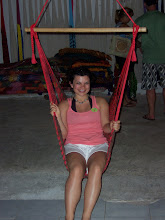
Click here to see pictures from both of my Thanksgivings
Click here to see pictures from a Mexican bull fight
(**Please note that this does have some pictures that might be considered disturbing, but it is worth looking at because it was an interesting cultural experience)
Thursday, December 3, 2009


Tuesday, December 1, 2009
Thanksgiving in Mexico
The week before Thanksgiving, while those of you in the States were happily surrounded by Thanksgiving food, decorations, sales, and overall ambience, we Americans here in Mexico were scouring the stores for items that would be staples in the United States at this time of year. Although Monterrey is close to the U.S., not very many people celebrate Thanksgiving here. There are those few Mexican-American families who celebrate it with turkey tacos (literally, I’m sure), but for the most part, it is a holiday that goes unnoticed (for obvious reasons, since it’s American!). However, for this very reason, my American friends and I decided to take advantage of this opportunity to share one of our culture’s most important traditions with both the Mexicans and the internationals here in Monterrey. In fact, I celebrated Thanksgiving twice!:
Thanksgiving #1: For the Rotaract Club
Kristen, the other Rotary Scholar here, and I realized that we wouldn’t have a more perfect opportunity than Thanksgiving to do exactly what Rotary has given us scholarships for: to further cross-cultural understanding and friendships. Thanksgiving is an all-American holiday that in and of itself celebrates friendship between cultures – the Native Americans and the pilgrims – and so we decided to share every aspect of it with the Monterrey Rotaract club: the food, the giving thanks, and the cross-cultural friendships.
We had this Thanksgiving dinner the Sunday before Thanksgiving. Kristen and I went shopping a couple of days before, crossing our fingers that we could actually find a turkey in Mexico at this time of year. We lucked out and found one at Costco! But you would never think that shopping for a holiday that for us is such a given would be so difficult. Certain things that would be at every grocery store in the U.S. we had to search high and low for in various stores here. And other things we didn’t think we would find we actually had no problem finding! For example, we had no problem finding a turkey or an already-made pumpkin pie, but we couldn’t find pumpkin-pie filling or packaged stuffing (we eventually found the stuffing at Wal-Mart after we had already started making our own). And don’t even try to get fresh cranberries here. Canned cranberries, yes, but you have to dig! But, after going back and forth to Wal-Mart, Soriana, and Costco, we eventually got everything together for the Thanksgiving dinner.
We spent all day cooking on Sunday and the Rotaractors arrived around 7 p.m. Neither Kristen nor I had ever made a turkey before, but it turned out GREAT! Since none of our guests had ever experienced Thanksgiving before, we first told them the story of Thanksgiving, and then each of us went around and said what we were thankful for.
We also had a surprise visit from a man from England – a co-worker of one of the Rotaractors. He too was very excited to experience his first Thanksgiving. It’s good to know that after a few hundred years, there can be perfectly friendly relations between Americans and British, especially at a holiday like Thanksgiving! :) Really though, it was such a great experience to have Mexicans, Americans, and British gathered together, all politics aside, to celebrate one of our greatest holidays, which has become simply a recognition of the wonderful family and friends – of every culture and ethnicity – in one’s life.
Thanksgiving #2: For My International and Mexican Friends
On actual Thanksgiving Day, my friend Linda (from California) and I cooked Thanksgiving dinner for our international and Mexican friends here. This time I knew exactly which stores sold which products, and I knew all about preparing the turkey (turkey guts don’t phase me anymore). I have to say, I was pretty proud of the cooking skills I developed, considering that I did not even used to be able to make pasta! (Yes, even after college).
Anyway, everything turned out great for this Thanksgiving too. No one here had ever experienced the holiday either, so again, we loved being able to bring this American tradition to Mexico! Also present were people from Germany, France, Australia, and Canada.
Stay tuned for pictures – will post them soon. Happy belated Thanksgiving to everyone – hope it was wonderful!
Thanksgiving #1: For the Rotaract Club
Kristen, the other Rotary Scholar here, and I realized that we wouldn’t have a more perfect opportunity than Thanksgiving to do exactly what Rotary has given us scholarships for: to further cross-cultural understanding and friendships. Thanksgiving is an all-American holiday that in and of itself celebrates friendship between cultures – the Native Americans and the pilgrims – and so we decided to share every aspect of it with the Monterrey Rotaract club: the food, the giving thanks, and the cross-cultural friendships.
We had this Thanksgiving dinner the Sunday before Thanksgiving. Kristen and I went shopping a couple of days before, crossing our fingers that we could actually find a turkey in Mexico at this time of year. We lucked out and found one at Costco! But you would never think that shopping for a holiday that for us is such a given would be so difficult. Certain things that would be at every grocery store in the U.S. we had to search high and low for in various stores here. And other things we didn’t think we would find we actually had no problem finding! For example, we had no problem finding a turkey or an already-made pumpkin pie, but we couldn’t find pumpkin-pie filling or packaged stuffing (we eventually found the stuffing at Wal-Mart after we had already started making our own). And don’t even try to get fresh cranberries here. Canned cranberries, yes, but you have to dig! But, after going back and forth to Wal-Mart, Soriana, and Costco, we eventually got everything together for the Thanksgiving dinner.
We spent all day cooking on Sunday and the Rotaractors arrived around 7 p.m. Neither Kristen nor I had ever made a turkey before, but it turned out GREAT!
 Since none of our guests had ever experienced Thanksgiving before, we first told them the story of Thanksgiving, and then each of us went around and said what we were thankful for.
 We also had a surprise visit from a man from England – a co-worker of one of the Rotaractors. He too was very excited to experience his first Thanksgiving. It’s good to know that after a few hundred years, there can be perfectly friendly relations between Americans and British, especially at a holiday like Thanksgiving! :) Really though, it was such a great experience to have Mexicans, Americans, and British gathered together, all politics aside, to celebrate one of our greatest holidays, which has become simply a recognition of the wonderful family and friends – of every culture and ethnicity – in one’s life.
Thanksgiving #2: For My International and Mexican Friends
On actual Thanksgiving Day, my friend Linda (from California) and I cooked Thanksgiving dinner for our international and Mexican friends here. This time I knew exactly which stores sold which products, and I knew all about preparing the turkey (turkey guts don’t phase me anymore). I have to say, I was pretty proud of the cooking skills I developed, considering that I did not even used to be able to make pasta! (Yes, even after college).
Anyway, everything turned out great for this Thanksgiving too. No one here had ever experienced the holiday either, so again, we loved being able to bring this American tradition to Mexico! Also present were people from Germany, France, Australia, and Canada.
Stay tuned for pictures – will post them soon. Happy belated Thanksgiving to everyone – hope it was wonderful!
Monday, November 16, 2009
Sunday, November 15, 2009
Weekend of El Día de los Muertos
The last weekend of October was Halloween for some, but for Mexico, it was the weekend of El Día de los Muertos (Day of the Dead), one of the main celebrations that Mexico is known for, in which the deceased are remembered and believed to come back for one day. Although officially I believe el Día de los Muertos is November 2, it is really celebrated the whole weekend before. Unfortunately for me, northern Mexico celebrates Halloween more than el Día de los Muertos (it is more celebrated in the South), but there were still some celebrations here in Monterrey.
On Friday night, October 30, I went with a few friends to an indigenous spiritual cleansing ritual in the Huasteca, which are the mountains right outside of Monterrey. We had no idea what to expect from this Noche de Temazcalli (“Night of Temazcalli”), except that we would sweat a lot, so we should bring a change of clothes and some towels.
We took a bus to a cabin in the mountains – there were about 20-30 people who came. When we arrived, we all gathered around a fire as a woman – our guide - briefly explained what we would be doing. A girl came around and performed a blessing on each of us with some kind of incense. After we were blessed, we took some twigs from a bag, threw them in the fire, and got down on hands and knees to enter a tent that was there.

The tent was made of branches and covered in blankets, and looked like an igloo. As we entered on hands and knees, we bowed our heads to the ground and then crawled in and sat down. We waited as each person individually crawled into the tent, and then the guide began to explain more about what we would be doing. She told us that the door to the tent would be closed four times, and during each time we would experience the temazcalli, which is a bath of vapor made from herb-scented water being poured onto hot, volcanic rocks. It originates from the pre-Hispanic cultures of Mexico and Central America, and the purpose is to cleanse the body and soul in conjunction with the essential elements (earth, water, fire, and air).
So they closed the door four times, and each time they poured the scented water on the hot rocks in the center of the tent. The room filled up with the HOT smell of herbs – it felt like a sauna. Everyone was dripping in sweat, and occasionally I had to lean down to the floor to get some cooler air. Each time, after about 15-20 minutes, they opened the tent door up so that we would have some fresh air. During this time, they would bring in new hot rocks, and then close the door again. Four times they did that, and we were in the tent a total of about two hours.
After sweating like crazy for two hours straight, it was intense to walk outside to the crispy mountain air, because we were soaked (it was then that we understood why we were supposed to bring a change of clothes and towels!). For the next hour, we gathered around the fire, getting to know each other. Several people had brought snacks of fruit and nuts and chocolate, and while some ate theirs, others threw theirs into the fire as an offering.
Other than the Noche de Temazcalli that weekend, several student organizations at Monterrey Tech set up altars on campus in honor of El Día de los Muertos. This is a popular tradition, which honors those who have passed away. For example, there was an altar set up by the Society of Hispanic Language and Literature Students in memory of two deceased Hispanic authors. :

There was also an altar in memory of Michael Jackson and Farrah Fawcett:

And that evening in class, my teacher brought in Day of the Dead Cake, a delicious pastry/cake that is eaten on El Día de los Muertos.
On Friday night, October 30, I went with a few friends to an indigenous spiritual cleansing ritual in the Huasteca, which are the mountains right outside of Monterrey. We had no idea what to expect from this Noche de Temazcalli (“Night of Temazcalli”), except that we would sweat a lot, so we should bring a change of clothes and some towels.
We took a bus to a cabin in the mountains – there were about 20-30 people who came. When we arrived, we all gathered around a fire as a woman – our guide - briefly explained what we would be doing. A girl came around and performed a blessing on each of us with some kind of incense. After we were blessed, we took some twigs from a bag, threw them in the fire, and got down on hands and knees to enter a tent that was there.

The tent was made of branches and covered in blankets, and looked like an igloo. As we entered on hands and knees, we bowed our heads to the ground and then crawled in and sat down. We waited as each person individually crawled into the tent, and then the guide began to explain more about what we would be doing. She told us that the door to the tent would be closed four times, and during each time we would experience the temazcalli, which is a bath of vapor made from herb-scented water being poured onto hot, volcanic rocks. It originates from the pre-Hispanic cultures of Mexico and Central America, and the purpose is to cleanse the body and soul in conjunction with the essential elements (earth, water, fire, and air).
So they closed the door four times, and each time they poured the scented water on the hot rocks in the center of the tent. The room filled up with the HOT smell of herbs – it felt like a sauna. Everyone was dripping in sweat, and occasionally I had to lean down to the floor to get some cooler air. Each time, after about 15-20 minutes, they opened the tent door up so that we would have some fresh air. During this time, they would bring in new hot rocks, and then close the door again. Four times they did that, and we were in the tent a total of about two hours.
After sweating like crazy for two hours straight, it was intense to walk outside to the crispy mountain air, because we were soaked (it was then that we understood why we were supposed to bring a change of clothes and towels!). For the next hour, we gathered around the fire, getting to know each other. Several people had brought snacks of fruit and nuts and chocolate, and while some ate theirs, others threw theirs into the fire as an offering.
Other than the Noche de Temazcalli that weekend, several student organizations at Monterrey Tech set up altars on campus in honor of El Día de los Muertos. This is a popular tradition, which honors those who have passed away. For example, there was an altar set up by the Society of Hispanic Language and Literature Students in memory of two deceased Hispanic authors. :

There was also an altar in memory of Michael Jackson and Farrah Fawcett:

And that evening in class, my teacher brought in Day of the Dead Cake, a delicious pastry/cake that is eaten on El Día de los Muertos.
Sunday, November 1, 2009
Pictures from Real de Catorce Trip...
...are posted! You can see more of the beauty that is Mexico here:
Weekend Trip to Real de Catorce
Saludos!
-Emily
Weekend Trip to Real de Catorce
Saludos!
-Emily
Friday, October 30, 2009
Pictures from Rotary and Rotaract Events in Monterrey
I finally put up some pictures from various Rotary meetings and events with Rotaract here in Monterrey! Check them out here:
Rotary and Rotaract in Monterrey
Enjoy!
Rotary and Rotaract in Monterrey
Enjoy!
Monday, October 26, 2009
A Long Over-due Update Including Trip to Real de Catorce
Hi everyone! Yep, I’m still here. Mexico hasn’t got the best of me yet. Where have I been for the last month? Well, first of all I apologize that it has been a month since the last time I wrote. Here’s a summary of the last month, which has been jam-packed with service, studying, new friends, and adventures:
ROTARACT
Rotaract is essentially a Rotary Club for people of 18-30 years of age, and there is a great Rotaract Club here in Monterrey. I’ve been participating as much as possible; they meet every Wednesday night and discuss various service projects, and I had the opportunity to participate in their “Noche de Lonche” one Sunday evening, where we made sandwiches for patients at a local hospital who are not from the area.

Read more about the Rotaract Club on their blog (in Spanish):
http://rotaractmty.blogspot.com/
ASOCIACIÓN ESTUDIANTIL POR LOS PUEBLOS INDÍGENAS (AEPI)
I’m still regularly attending meetings with this student organization at Tec that encourages awareness of indigenous people’s rights and situations. It’s really an amazing way to be exposed to more of Mexican society, which was essentially founded upon the indigenous culture, and to see how proud Mexicans are of their history and culture.
AEPI continues to be a part of the program Creando Espacios de Inclusión, in which we get together with indigenous youth in Monterrey on Saturdays and discuss a different topic every week, to make friends and to learn more about each other’s culture. My favorite session was one in which each person talked about the community he or she came from – so not only did I get to learn about various indigenous villages in Mexico, but there was one AEPI member from Uruguay! And I got to share about my home state of South Carolina, and everyone loved hearing about that.
BEING A GRAD STUDENT AT MONTERREY TEC…
…is a lot of work! I have a new respect for everyone with a Master’s degree, as well as all Mexican students:). I have a semester project for each of my four classes, and since we only have a month left of the semester (so hard to believe), it will be down to the wire soon! It’s good though – I’m learning the way the educational system works in Mexico (at least at Tec, it’s very research-oriented and group-project-focused, which is a great way to get to know the students in my class and practice my Spanish).
WEEKEND TRIP TO REAL DE CATORCE
Although I’m being kept pretty busy, I’ve made sure to give myself time to see more of this beautiful country. My boyfriend Zack came from South Carolina to visit me for a couple of weeks, and although I spent a lot of time showing him around Monterrey (places such as the Cola de Caballo waterfall and the Grutas de Garcia caves, which I described in previous posts), we also went away the first weekend in October with some of my friends here to Real de Catorce, a little colonial town in the mountain about 5 hours from Monterrey in the state of San Luis Potosi.
Have you ever seen the movie “The Mexican”? It was filmed in Real de Catorce. If you haven’t, Real can be described as Mexican western cowboy meets Mexican indigenous hippy. We decided to drive my car there, and it was a smooth, peaceful ride on a Friday afternoon with incredible views:

…until my car got stuck halfway up the mountain, at the top of which is Real de Catorce.
We were incredibly lucky though, because right then some natives were driving by. They stopped and came over to help us try and figure out what was wrong. We realized it was a problem with the transmission, because it wasn’t changing gears, so they put in some transmission fluid that they had handy. I also happened to need oil, so they took us to a little convenience store a little bit further up the mountain, and that was enough to get me to the top.
In order to get to Real de Catorce, you have to park your car in a dirt parking lot and walk through a tunnel about 2 km long. Since it was dark at this point, the tunnel was particularly spooky. In fact, Real is known for being a ghost town, although at the particular time that we were there, there was a festival going on called Fiesta de San Francisco, during which time 150,000 pilgrims come to see the figure of Saint Francis of Assisi in the church there. But even though there were people around, it was still very eerie walking through that tunnel:

It was also a very long tunnel, so about halfway through we hitched a ride with a horse and cart.
At the end of the tunnel was Real de Catorce. We came out and immediately it felt as if we had jumped back about 100 years. There were cobblestone paths and vendors on the streets, selling delicious-smelling tacos, religious souvenirs and little knick-knacks. The air was fresh and crisp and literally everything about that town was in stark contrast to the big, loud city of Monterrey. I love Monterrey, but it was a welcome change.
We wandered through the crowds of pilgrims and vendors, up and down cobblestone hills, until we came to our hotel at the other end of the village (that description makes it sound far away, but the whole town was actually pretty small. In fact, there was essentially just one main market place, with a few side streets). After we got settled into our hotel, we went in search of food, of which the options were: tacos, burritos, and other versions of tacos and burritos with different names – all from street vendors. So, we ordered delicious pork burritos and wondered why they don’t make ‘em like that in the States!
Real already seemed like a great town, but with not much to offer for nightlife. So, we opted to go relax at the bar atop our hotel, where we found a great drum band playing an indigenous-style beat. All of a sudden a indigenous man (probably a Huichol, the primary indigenous group from Real de Catorce) walked out into the middle of the room, with his hair pulled in front of his face so we couldn’t see his face at all, body painted, and wearing a striped skirt. He carried a decorated cane with a painted animal skull at the top. He began dancing to the drum beat in a rhythmic yet flowing fashion, as all eyes were on him. And then, slowly, everyone else in the room began to dance to the drums–and we joined in too!
One of the things that Real de Catorce is known for is a plant called peyote. It is a Huichol ritual to walk to where the peyote plants are, cut them, take them back, and eat them for a spiritual “experience.” For this reason, Real is known for being a spiritual town, but it was also incredibly interesting to see the contrast between 1) Mexico’s Catholic religion, manifested in the many pilgrims there to pay homage to St. Francis of Assisi, and 2) the spirituality of the indigenous earth-focused religion of the people who are native to Real. From my participation in AEPI and seeing how the students in that group are trying so hard to make the Mexican people more aware of their indigenous roots, it was really refreshing to see these two contrasting cultures exist harmoniously that weekend in a little mountain town.
The next morning we relaxed at our hotel, which had breathtaking views of the valley below:

Then we spent some time wandering through the crowded streets of Real, looking at the items for sale and taking in the fresh air and incredible sites. Vendor stands lined the streets and they had everything from little St. Francis figurines, to random plastic toys for kids, to ponchos, to carved imitation peyote plants. They also of course had food, drinks, and offered a variety of services like designs painted on baseball caps (my friend Claire got “MEXICO” painted on a white hat in the colors of the Mexican flag).
There were also cowboy-looking men coming up to us asking us if we wanted to ride their horses, so we opted for that the next day.
Sunday was another beautiful sunny day in the mountains, and after breakfast we headed out to the center of town to find the man with the horses.
He said we would be riding the horses to the Pueblo Fantasmo (Ghost Town). It was a little scary at first, going up and down the little cobblestone hills in the town, but I was just crossing my fingers that the horses were used to it and knew what they were doing. As we got further out of town, though, I realized it was only going to get worse. It was then that it occurred to me that the Pueblo Fantasmo was at the top of another mountain, so we couldn’t avoid going up at a very steep incline. I’ve always had a little fear of heights, and it only added to the scariness factor that we were riding horses about two feet from the edge on rocky, unpaved pathways, where they could easily have slipped. The whole time up we were all thinking, “This is going to be sooo much worse going down…”
BUT we made it and it was definitely worth it. The town was abandoned ruins at the top of a mountain,

with views stretching for miles, including a bird’s-eye view of the little town of Real de Catorce.
The way back down was scarier and what we were all dreading. We had to ride the horses going down a steep incline about two feet from the edge on rocky, unpaved pathways. On the way up, we ended up drifting apart into two separate groups, but on the way down we were all clumping up into one group. To make matters worse, our guide was in the back and would whip whichever horse was in the back to get him to go faster! So it ended up being a traffic jam for much of the way down, as each horse scrambled not to be last, to our detriment. At one point I thought I was going to fall off because there was a horse so close to me that he pushed up against me and my horse and knocked my leg out of the stirrup!
But really, there was not much to worry about; the horses had probably walked that trek every day and it was a little bit of a thrilling adventure.
When we got back to Real, we grabbed our things and trekked back to our car, up and down the little hills in the town, and through the 2 km tunnel. Since it was Sunday, everyone who was there for the weekend was leaving, so walking through the tunnel felt like some massive evacuation due to some pandemic or impending natural disaster.
On the other side of the tunnel, though, it was still sunny and my car was still there, so we thought that was the end to our weekend adventure.
Wrong. Not even halfway back, we pulled over to a Pemex gas station (the only gas station in Mexico – it’s essentially a monopoly) to fill up, and they told me they didn’t have regular gas so we left to go to the next one down the highway. That didn’t happen, though, because as soon as we left the gas station my car wouldn’t shift gears or go past 40mph, so we turned back around and went back to the Pemex we were just at.
I feel like my Spanish has improved a lot since I’ve been here, but I probably wouldn’t even know some car vocabulary in English, so I thought this was a hopeless situation. Fortunately, there was a man stopped to get gas who spoke both English and Spanish completely fluently, and he helped us translate the problem to the attendants. They couldn’t do much, but they said there was a mechanic in a town called Matehuala about 45 minutes away. Since it was already almost 7 p.m., we decided that the best option would be to just get the mechanic to come with a tow truck and take us back to Monterrey (about a 2.5 hr drive).
…He finally came three hours later. At least we had five of us to keep us entertained, access to the Oxxo in Pemex (Oxxo is the main Mexican convenience store – like a 7-11, which is also here), and the Pemex workers to keep checking in to make sure the mechanic came. When he finally showed up at 10 p.m., we discovered that he wasn’t going to be able to take us all the way to my apartment in Monterrey; he would have to leave us at a Soriana (the Mexican version of Walmart) right outside the city, because there were certain restrictions that prohibited him from entering the city limit. So when we finally got to the Soriana at 1 a.m., we prayed and prayed that my car would work to drive the next 30 minutes to my apartment, and thank god it did.
I think a true test of the mastery of another language, culture, and country is how one handles situations of adversity. Granted, at the time I was pretty upset and worried – anyone I was with can attest to that :P – but all you can really do is look at what you learned from the situation:
• I didn’t come here to be a tourist – I came here to live as much like Mexicans do as I could, to really get a grasp of their language and culture. Obviously, from time to time Mexicans have to deal with car breakdowns, so it was interesting to see how that works here.
• I learned a lot more about how cars work. When I was 16, my dad wouldn’t even let me get my license until I explained to him how a transmission works. Well, I’d since forgotten all of that, but it turned out that my transmission gears were just worn down from years of use, so I had to re-learn all about transmissions to understand what had happened to my car.
• I learned some new vocabulary that I probably wouldn’t have learned otherwise. For example, “cambios” refers to “gears”, and “camión remolcador” is “tow truck” (fortunately I always carry my dictionary with me so I could explain to them that I wanted a tow truck).
• I developed a new belief that there are genuinely good mechanics in the world. When we got back to Monterrey, we took my car to a transmission shop, and the mechanic there was so helpful and nice. For example, it was going to be 4 or 5 days for my car to be fixed, and although I asked him if it could be ready any sooner, he said he didn’t think so. However, he knew how badly I wanted it and so he got to it first and it was ready in 3 days! Also, when we went to bring it in, he saw us standing around afterwards looking confused (we were actually deciding if we wanted to go to the restaurant across the street), and he came up and asked if we needed a ride somewhere, since he was going home for lunch anyway!
• I realized how glad I am I did bring my car here. A lot of people thought that I was crazy, but like I said, I didn’t come here to be a tourist. Monterrey is not a very walkable city, so it’s so nice to be able to drive to places like Rotary meetings. Sure, I’ve gotten lost about as much as I’ve found my way, but that’s the way to really learn the ins-and-outs of the city.
• And last but not least, this story now serves as an excellent icebreaker when there’s an awkward language-barrier-invoked silence!
ROTARACT
Rotaract is essentially a Rotary Club for people of 18-30 years of age, and there is a great Rotaract Club here in Monterrey. I’ve been participating as much as possible; they meet every Wednesday night and discuss various service projects, and I had the opportunity to participate in their “Noche de Lonche” one Sunday evening, where we made sandwiches for patients at a local hospital who are not from the area.

Read more about the Rotaract Club on their blog (in Spanish):
http://rotaractmty.blogspot.com/
ASOCIACIÓN ESTUDIANTIL POR LOS PUEBLOS INDÍGENAS (AEPI)
I’m still regularly attending meetings with this student organization at Tec that encourages awareness of indigenous people’s rights and situations. It’s really an amazing way to be exposed to more of Mexican society, which was essentially founded upon the indigenous culture, and to see how proud Mexicans are of their history and culture.
AEPI continues to be a part of the program Creando Espacios de Inclusión, in which we get together with indigenous youth in Monterrey on Saturdays and discuss a different topic every week, to make friends and to learn more about each other’s culture. My favorite session was one in which each person talked about the community he or she came from – so not only did I get to learn about various indigenous villages in Mexico, but there was one AEPI member from Uruguay! And I got to share about my home state of South Carolina, and everyone loved hearing about that.
BEING A GRAD STUDENT AT MONTERREY TEC…
…is a lot of work! I have a new respect for everyone with a Master’s degree, as well as all Mexican students:). I have a semester project for each of my four classes, and since we only have a month left of the semester (so hard to believe), it will be down to the wire soon! It’s good though – I’m learning the way the educational system works in Mexico (at least at Tec, it’s very research-oriented and group-project-focused, which is a great way to get to know the students in my class and practice my Spanish).
WEEKEND TRIP TO REAL DE CATORCE
Although I’m being kept pretty busy, I’ve made sure to give myself time to see more of this beautiful country. My boyfriend Zack came from South Carolina to visit me for a couple of weeks, and although I spent a lot of time showing him around Monterrey (places such as the Cola de Caballo waterfall and the Grutas de Garcia caves, which I described in previous posts), we also went away the first weekend in October with some of my friends here to Real de Catorce, a little colonial town in the mountain about 5 hours from Monterrey in the state of San Luis Potosi.
Have you ever seen the movie “The Mexican”? It was filmed in Real de Catorce. If you haven’t, Real can be described as Mexican western cowboy meets Mexican indigenous hippy. We decided to drive my car there, and it was a smooth, peaceful ride on a Friday afternoon with incredible views:

…until my car got stuck halfway up the mountain, at the top of which is Real de Catorce.
We were incredibly lucky though, because right then some natives were driving by. They stopped and came over to help us try and figure out what was wrong. We realized it was a problem with the transmission, because it wasn’t changing gears, so they put in some transmission fluid that they had handy. I also happened to need oil, so they took us to a little convenience store a little bit further up the mountain, and that was enough to get me to the top.
In order to get to Real de Catorce, you have to park your car in a dirt parking lot and walk through a tunnel about 2 km long. Since it was dark at this point, the tunnel was particularly spooky. In fact, Real is known for being a ghost town, although at the particular time that we were there, there was a festival going on called Fiesta de San Francisco, during which time 150,000 pilgrims come to see the figure of Saint Francis of Assisi in the church there. But even though there were people around, it was still very eerie walking through that tunnel:

It was also a very long tunnel, so about halfway through we hitched a ride with a horse and cart.
At the end of the tunnel was Real de Catorce. We came out and immediately it felt as if we had jumped back about 100 years. There were cobblestone paths and vendors on the streets, selling delicious-smelling tacos, religious souvenirs and little knick-knacks. The air was fresh and crisp and literally everything about that town was in stark contrast to the big, loud city of Monterrey. I love Monterrey, but it was a welcome change.
We wandered through the crowds of pilgrims and vendors, up and down cobblestone hills, until we came to our hotel at the other end of the village (that description makes it sound far away, but the whole town was actually pretty small. In fact, there was essentially just one main market place, with a few side streets). After we got settled into our hotel, we went in search of food, of which the options were: tacos, burritos, and other versions of tacos and burritos with different names – all from street vendors. So, we ordered delicious pork burritos and wondered why they don’t make ‘em like that in the States!
Real already seemed like a great town, but with not much to offer for nightlife. So, we opted to go relax at the bar atop our hotel, where we found a great drum band playing an indigenous-style beat. All of a sudden a indigenous man (probably a Huichol, the primary indigenous group from Real de Catorce) walked out into the middle of the room, with his hair pulled in front of his face so we couldn’t see his face at all, body painted, and wearing a striped skirt.
 He carried a decorated cane with a painted animal skull at the top. He began dancing to the drum beat in a rhythmic yet flowing fashion, as all eyes were on him. And then, slowly, everyone else in the room began to dance to the drums–and we joined in too!
 One of the things that Real de Catorce is known for is a plant called peyote. It is a Huichol ritual to walk to where the peyote plants are, cut them, take them back, and eat them for a spiritual “experience.” For this reason, Real is known for being a spiritual town, but it was also incredibly interesting to see the contrast between 1) Mexico’s Catholic religion, manifested in the many pilgrims there to pay homage to St. Francis of Assisi, and 2) the spirituality of the indigenous earth-focused religion of the people who are native to Real. From my participation in AEPI and seeing how the students in that group are trying so hard to make the Mexican people more aware of their indigenous roots, it was really refreshing to see these two contrasting cultures exist harmoniously that weekend in a little mountain town.
The next morning we relaxed at our hotel, which had breathtaking views of the valley below:

Then we spent some time wandering through the crowded streets of Real, looking at the items for sale and taking in the fresh air and incredible sites. Vendor stands lined the streets and they had everything from little St. Francis figurines, to random plastic toys for kids, to ponchos, to carved imitation peyote plants. They also of course had food, drinks, and offered a variety of services like designs painted on baseball caps (my friend Claire got “MEXICO” painted on a white hat in the colors of the Mexican flag).
There were also cowboy-looking men coming up to us asking us if we wanted to ride their horses, so we opted for that the next day.
Sunday was another beautiful sunny day in the mountains, and after breakfast we headed out to the center of town to find the man with the horses.
He said we would be riding the horses to the Pueblo Fantasmo (Ghost Town). It was a little scary at first, going up and down the little cobblestone hills in the town, but I was just crossing my fingers that the horses were used to it and knew what they were doing. As we got further out of town, though, I realized it was only going to get worse. It was then that it occurred to me that the Pueblo Fantasmo was at the top of another mountain, so we couldn’t avoid going up at a very steep incline. I’ve always had a little fear of heights, and it only added to the scariness factor that we were riding horses about two feet from the edge on rocky, unpaved pathways, where they could easily have slipped. The whole time up we were all thinking, “This is going to be sooo much worse going down…”
BUT we made it and it was definitely worth it. The town was abandoned ruins at the top of a mountain,

with views stretching for miles, including a bird’s-eye view of the little town of Real de Catorce.
The way back down was scarier and what we were all dreading. We had to ride the horses going down a steep incline about two feet from the edge on rocky, unpaved pathways. On the way up, we ended up drifting apart into two separate groups, but on the way down we were all clumping up into one group. To make matters worse, our guide was in the back and would whip whichever horse was in the back to get him to go faster! So it ended up being a traffic jam for much of the way down, as each horse scrambled not to be last, to our detriment. At one point I thought I was going to fall off because there was a horse so close to me that he pushed up against me and my horse and knocked my leg out of the stirrup!
But really, there was not much to worry about; the horses had probably walked that trek every day and it was a little bit of a thrilling adventure.
When we got back to Real, we grabbed our things and trekked back to our car, up and down the little hills in the town, and through the 2 km tunnel. Since it was Sunday, everyone who was there for the weekend was leaving, so walking through the tunnel felt like some massive evacuation due to some pandemic or impending natural disaster.
On the other side of the tunnel, though, it was still sunny and my car was still there, so we thought that was the end to our weekend adventure.
Wrong. Not even halfway back, we pulled over to a Pemex gas station (the only gas station in Mexico – it’s essentially a monopoly) to fill up, and they told me they didn’t have regular gas so we left to go to the next one down the highway. That didn’t happen, though, because as soon as we left the gas station my car wouldn’t shift gears or go past 40mph, so we turned back around and went back to the Pemex we were just at.
I feel like my Spanish has improved a lot since I’ve been here, but I probably wouldn’t even know some car vocabulary in English, so I thought this was a hopeless situation. Fortunately, there was a man stopped to get gas who spoke both English and Spanish completely fluently, and he helped us translate the problem to the attendants. They couldn’t do much, but they said there was a mechanic in a town called Matehuala about 45 minutes away. Since it was already almost 7 p.m., we decided that the best option would be to just get the mechanic to come with a tow truck and take us back to Monterrey (about a 2.5 hr drive).
…He finally came three hours later. At least we had five of us to keep us entertained, access to the Oxxo in Pemex (Oxxo is the main Mexican convenience store – like a 7-11, which is also here), and the Pemex workers to keep checking in to make sure the mechanic came. When he finally showed up at 10 p.m., we discovered that he wasn’t going to be able to take us all the way to my apartment in Monterrey; he would have to leave us at a Soriana (the Mexican version of Walmart) right outside the city, because there were certain restrictions that prohibited him from entering the city limit. So when we finally got to the Soriana at 1 a.m., we prayed and prayed that my car would work to drive the next 30 minutes to my apartment, and thank god it did.
I think a true test of the mastery of another language, culture, and country is how one handles situations of adversity. Granted, at the time I was pretty upset and worried – anyone I was with can attest to that :P – but all you can really do is look at what you learned from the situation:
• I didn’t come here to be a tourist – I came here to live as much like Mexicans do as I could, to really get a grasp of their language and culture. Obviously, from time to time Mexicans have to deal with car breakdowns, so it was interesting to see how that works here.
• I learned a lot more about how cars work. When I was 16, my dad wouldn’t even let me get my license until I explained to him how a transmission works. Well, I’d since forgotten all of that, but it turned out that my transmission gears were just worn down from years of use, so I had to re-learn all about transmissions to understand what had happened to my car.
• I learned some new vocabulary that I probably wouldn’t have learned otherwise. For example, “cambios” refers to “gears”, and “camión remolcador” is “tow truck” (fortunately I always carry my dictionary with me so I could explain to them that I wanted a tow truck).
• I developed a new belief that there are genuinely good mechanics in the world. When we got back to Monterrey, we took my car to a transmission shop, and the mechanic there was so helpful and nice. For example, it was going to be 4 or 5 days for my car to be fixed, and although I asked him if it could be ready any sooner, he said he didn’t think so. However, he knew how badly I wanted it and so he got to it first and it was ready in 3 days! Also, when we went to bring it in, he saw us standing around afterwards looking confused (we were actually deciding if we wanted to go to the restaurant across the street), and he came up and asked if we needed a ride somewhere, since he was going home for lunch anyway!
• I realized how glad I am I did bring my car here. A lot of people thought that I was crazy, but like I said, I didn’t come here to be a tourist. Monterrey is not a very walkable city, so it’s so nice to be able to drive to places like Rotary meetings. Sure, I’ve gotten lost about as much as I’ve found my way, but that’s the way to really learn the ins-and-outs of the city.
• And last but not least, this story now serves as an excellent icebreaker when there’s an awkward language-barrier-invoked silence!
Subscribe to:
Posts (Atom)